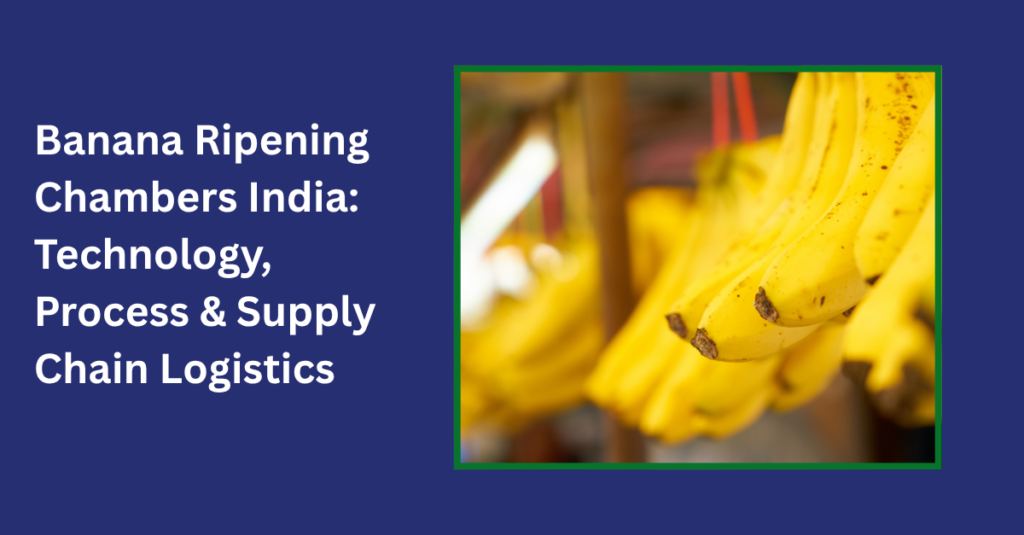
Banana ripening chambers India use controlled temperature, humidity, airflow, and ethylene exposure to achieve more uniform and predictable ripening. The process typically involves inspection, chamber loading, controlled ripening, monitoring, and timely dispatch. Efficient supply chain logistics after ripening is equally important for maintaining freshness, reducing handling losses, and reaching markets on schedule.
Banana ripening chambers India provide controlled conditions that help businesses manage ripening more consistently than uncontrolled methods. However, ripening is only one stage of the journey. Once bananas are ready, timely transportation, careful handling, and reliable distribution become equally important. JustDeliveries helps businesses manage temperature-sensitive logistics and fresh-produce movement. The real challenge begins when the chamber doors open.
What Is a Banana Ripening Chamber?
A banana ripening chamber is a specially designed enclosed space where environmental conditions are managed to encourage controlled and uniform fruit ripening. Instead of relying entirely on ambient conditions, commercial operators can manage factors such as temperature, humidity, airflow, and ethylene exposure according to the fruit and operating requirements.
The objective is simple: make the ripening cycle more predictable.
For wholesalers, distributors, retailers and food businesses, consistency matters because bananas may need to reach different markets at specific stages of ripeness. A controlled process makes it easier to plan inventory, dispatches, and customer deliveries.
What Is Banana Ripening Technology?
Modern banana ripening technology combines several systems rather than relying on a single piece of equipment.
Ethylene Management
Ethylene is naturally associated with the ripening of climacteric fruits such as bananas. Commercial ripening systems use controlled exposure to support a more coordinated ripening response.
The important consideration is controlled application. Ripening conditions should be established according to the banana variety, maturity, chamber design and operating protocol rather than using one universal setting for every situation.
Temperature Control
Temperature influences the pace and consistency of ripening. A commercial chamber therefore uses refrigeration or temperature-management equipment to create a stable environment.
Temperature control also needs to work alongside airflow. Simply changing the temperature is not enough if different parts of the chamber experience significantly different conditions.
Humidity Management
Humidity affects moisture retention and fruit quality during ripening. Appropriate relative humidity helps minimise excessive moisture loss while supporting the desired ripening environment.
Airflow and Ventilation
Fans and ventilation systems help distribute air and maintain more consistent chamber conditions. Proper airflow is particularly important when chambers are loaded at commercial scale, where poor circulation can contribute to uneven ripening.
Monitoring and Automation
Sensors and control systems can help operators monitor temperature and humidity and identify changes during the cycle. Better monitoring also creates useful operational records that can support quality control and process improvement.
How Does the Ripening Chamber Process Work?
The ripening chamber process is not simply a matter of putting green bananas inside and waiting. Each stage influences the final result.
1. Inspect and Sort the Bananas
Incoming fruit should be checked for maturity, physical damage, quality, and uniformity. Sorting helps prevent significantly different batches from being managed as though they have identical ripening requirements.
2. Load the Chamber Correctly
Bananas need to be positioned in a way that allows adequate air circulation. Overloading or poor arrangement can interfere with uniform environmental conditions.
3. Establish Controlled Conditions
The chamber is brought to the required operating conditions for the specific batch. Temperature, humidity, and airflow should be monitored rather than assumed.
4. Apply Ethylene Under Controlled Conditions
Where ethylene-based ripening is used, exposure is managed according to the operating protocol. The purpose is to initiate and coordinate ripening rather than simply accelerate it without control.
5. Monitor the Ripening Cycle
Operators assess colour, firmness, and overall development while tracking chamber conditions. Monitoring allows adjustments when a batch is progressing differently from expectations.
6. Prepare for Dispatch
Once the desired ripeness is reached, timing becomes critical. Bananas should be prepared for transportation according to their destination, expected transit time, and customer requirements.
This final step connects ripening directly with banana supply chain logistics.
Major Components of a Commercial Ripening Chamber
A typical commercial system can include several interconnected components:
- Insulated chamber panels: Help maintain the desired internal environment.
- Refrigeration system: Supports temperature management.
- Ethylene application system: Enables controlled ripening conditions where applicable.
- Humidity management: Helps maintain suitable moisture conditions.
- Fans and ventilation: Support air movement and uniformity.
- Sensors and controllers: Help monitor and regulate operating conditions.
- Safety systems: Support responsible operation and maintenance.
The right configuration depends on chamber capacity, banana variety, throughput, location, operating conditions, and business requirements.
Banana Ripening Chambers India: What Businesses Should Consider
Choosing a chamber should begin with the business requirement rather than simply comparing equipment prices.
Capacity and Throughput
Estimate how much fruit needs to be processed per cycle and how frequently chambers will be used. A facility designed around actual throughput is more practical than selecting capacity based solely on the lowest upfront cost.
Location
The chamber’s location can influence logistics costs and turnaround time. Proximity to sourcing areas, wholesale markets, distribution centres or major consumption zones should be considered.
Energy Efficiency
Insulation quality, refrigeration performance, chamber design and operating practices can all influence energy consumption. Long-term operating costs deserve attention alongside installation costs.
Monitoring and Support
Reliable sensors, controls, maintenance support, and technical assistance can be valuable for commercial operations. Downtime during a critical ripening cycle can disrupt both inventory and downstream deliveries.
What Affects Banana Ripening Chamber Cost in India?
There is no single price applicable to every facility. The overall investment can depend on:
- Chamber capacity
- Insulation specifications
- Refrigeration capacity
- Ethylene system
- Humidity-control requirements
- Automation level
- Electrical infrastructure
- Installation
- Site conditions
- Maintenance and after-sales support
When comparing quotations, businesses should look beyond the initial equipment price. Energy consumption, service availability, component quality, and operational reliability can have a significant effect on the total cost of ownership.
Understanding Banana Supply Chain Logistics
Ripening is only one link in the larger banana supply chain.
A typical journey can look like:
Farm → Collection → Transportation → Ripening → Holding/Conditioning → Distribution → Retail
Each transition introduces handling and timing considerations.
Before ripening, bananas may need to travel from farms or collection points to a ripening facility. After ripening, the urgency changes because the fruit is now moving closer to its intended consumption stage.
This makes coordination especially important. A completed ripening cycle without a reliable dispatch plan can create avoidable pressure on inventory.
Why Logistics After Ripening Matters
Good ripening technology cannot compensate for poorly managed transportation.
Once bananas leave the chamber, businesses need to consider:
- Transit duration
- Loading and unloading
- Route planning
- Vehicle suitability
- Delivery windows
- Temperature requirements
- Number of destinations
- Handling practices
- Real-time shipment visibility
The objective is to connect the ripening schedule with the delivery schedule.
For example, if a batch is ready but the vehicle arrives late, the additional waiting period may affect the product’s commercial window. Better coordination between chamber operations and transportation can therefore improve supply-chain planning.
How Temperature-Controlled Logistics Supports Fresh Produce
Temperature-sensitive logistics is not about putting every fresh product into the same temperature environment. The appropriate transport conditions depend on the product, maturity, route, and handling requirements.
For businesses moving fresh produce, a logistics partner can support transportation planning, monitoring, and distribution while the producer or distributor focuses on sourcing and product operations.
JustDeliveries positions itself as an F&B-focused logistics partner offering cold-chain and dry logistics, with services spanning intra-city logistics, inter-city transportation, warehousing, and 3PL. Its platform highlights real-time tracking, temperature monitoring, proof of delivery, and analytics.
Common Banana Supply Chain Challenges
Delays After Ripening
A delay between ripening completion and dispatch can make inventory planning more difficult. Dispatch schedules should therefore be aligned with expected ripening cycles.
Excessive Handling
Repeated loading and unloading increases the opportunity for physical damage. A planned movement process can reduce unnecessary touchpoints.
Poor Route Planning
Multiple delivery points can complicate schedules. Route planning and consolidated distribution can help businesses manage delivery windows more effectively.
Limited Visibility
When businesses cannot see where a shipment is or whether a temperature-sensitive vehicle is operating as expected, responding to delays becomes harder.
Mismatch Between Demand and Ripening
Ripening too much fruit without sufficient downstream demand can create inventory pressure. Demand forecasting and coordinated logistics can help align supply with market requirements.
Banana Ripening Chambers India and Logistics: Why They Must Work Together
The commercial value of controlled ripening does not end when the fruit reaches the desired colour or firmness.
The stronger approach is to connect:
Ripening planning → Inventory planning → Dispatch scheduling → Transportation → Distribution → Retail replenishment
This integrated approach can make the supply chain more predictable.
In practical terms, the ripening team should know when fruit is likely to be ready, while the logistics team should know when and where it needs to move. That coordination becomes increasingly important as volumes and distribution locations increase.
How to Build a More Efficient Banana Supply Chain
Businesses can strengthen their operations by following a few practical principles:
- Understand demand before scheduling ripening.
- Choose chamber capacity according to actual throughput.
- Standardise operating procedures for each banana batch.
- Coordinate ripening completion with vehicle availability.
- Minimise unnecessary handling.
- Use appropriate transportation for the product and route.
- Track shipments and delivery performance.
- Review wastage, delays and logistics costs regularly.
- Use warehousing strategically when distribution requires it.
- Scale transportation and storage capacity alongside business growth.
This approach turns the ripening chamber from an isolated facility into one part of a connected supply chain.
Why Choose JustDeliveries for Fresh Produce Logistics?
For businesses that need to move perishables after processing or ripening, logistics needs to be dependable, visible, and aligned with delivery schedules.
JustDeliveries offers B2B logistics solutions for the F&B sector, including perishable transportation, temperature-controlled vehicles, warehousing and 3PL support. Its warehousing offering also highlights dedicated refrigerated and dry vehicles, real-time vehicle and temperature tracking, reporting, and checkpoint logs.
For a banana business, that can translate into a more connected movement plan, from the point where fruit becomes market-ready to the point where it reaches the next distribution or retail destination.
If your business is scaling banana distribution or other fresh-produce operations, JustDeliveries can help you plan temperature-sensitive transportation, warehousing, and B2B distribution around your operational needs. The right logistics partner can help turn a carefully managed ripening process into a more reliable end-to-end supply chain.
Frequently Asked Questions
Q1. How long does the ripening chamber process take?
The duration varies according to banana variety, maturity at loading, chamber conditions, and the desired ripeness. Commercial operators should follow a validated operating protocol rather than relying on one fixed duration for every batch.
Q2. Can banana ripening be controlled in a chamber?
Yes. A commercial ripening chamber can control environmental factors such as temperature, humidity, airflow, and, where applicable, ethylene exposure. These controls help create a more consistent ripening environment.
Q3. Is ethylene used in banana ripening?
Yes. Ethylene is associated with the natural ripening process of bananas and can be used under controlled conditions in commercial ripening systems. Application should follow appropriate technical procedures and applicable food-safety requirements.
Q4. What is the cost of a banana ripening chamber in India?
Cost varies based on chamber capacity, insulation, refrigeration, automation, ethylene systems, installation, and site requirements. A business should compare both initial investment and long-term operating and maintenance costs.
Q5. Will transportation affect bananas after ripening?
Yes. Transit duration, handling, vehicle conditions, route planning, and delivery timing can influence product quality after ripening. Coordinating dispatch with the ripening schedule is therefore important.
Q6. Why is humidity important during banana ripening?
Humidity influences moisture retention and fruit quality during ripening. Maintaining suitable conditions can help reduce excessive moisture loss and support more consistent results.
Q7. What are the main components of a banana ripening chamber?
Key components generally include an insulated chamber, refrigeration system, ethylene application system where applicable, humidity management, air-circulation equipment, sensors, and control systems.
Q8. How can businesses improve banana supply chain logistics?
Businesses can improve logistics by coordinating ripening and dispatch schedules, reducing unnecessary handling, planning routes, selecting suitable transportation, monitoring shipments, and reviewing delivery and wastage data regularly.

Mansi Mahansaria
I’m Mansi Mahansaria, CEO and Founder of JustDeliveries, a B2B logistics company specializing in the food and beverage sector. With a background in Chemical Technology (ICT Mumbai), an MBA (FMS Delhi), and experience at IDFC Private Equity and Tata Group, I’ve built a plug-and-play logistics network helping F&B brands scale efficiently. I also share insights on entrepreneurship and logistics at industry and academic events.