
Pay per use chilled and frozen vehicles - book easily via App
On demand vehicles in mumbai with live tracking and temperature monitoring ! Book instantly ! Useful for quick commerce appointments, outlet replenishments, b2b orders or emergency deliveries
- 60 min
- vehicle placement
- 100%
- dedicated, never shared


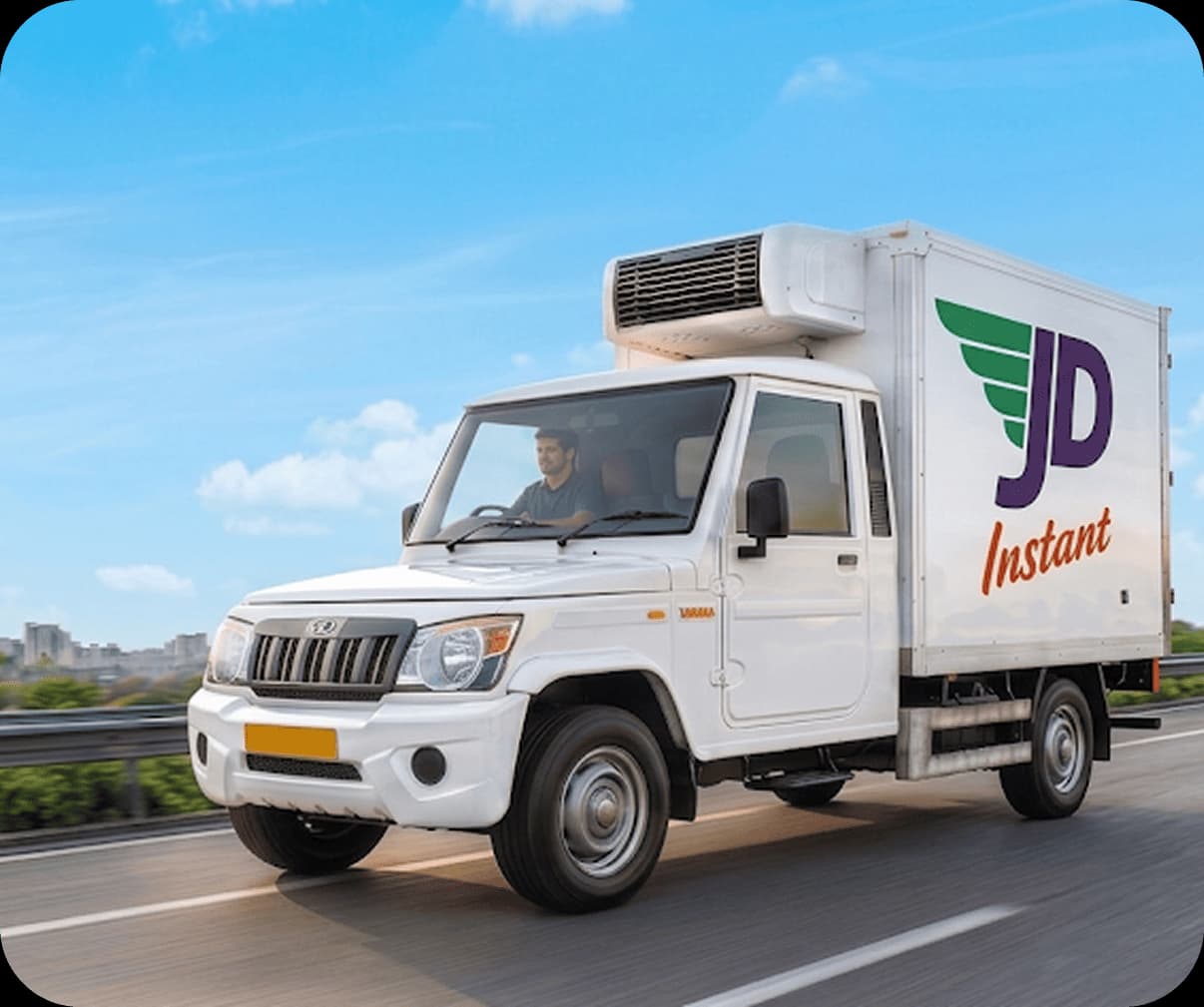
We built JD Instant to solve a real challenge
The Challenge
Not every business needs a refrigerated vehicle every day. Many only need one a few times a week.
The Gap
Growing brands shouldn't have to choose between expensive long-term contracts and unreliable last-minute arrangements.
The Solution
Reliable chilled and frozen vehicles, available when you need them. Book when you need, pay only for what you use.
Trusted by leading F&B brands in Mumbai










From request to delivered, verified at every step.
Enter trip details
Add pickup and drop locations, shipment details, and the temperature range your product needs.
Choose booking type
Book instantly for urgent runs, or schedule a reefer vehicle in advance for planned deliveries.
Confirm booking
Review the fare and trip details. Driver and vehicle information are shared before pickup.
Verify, track & deliver
Verify vehicle temperature, start the trip with OTP, track it live, and close it out with receiver OTP and proof of delivery.
Trusted by India’s best F&B brands
Reliable cold chain logistics helped us scale frozen inventory across multiple outlets.

Biggies Burger
QSR · Frozen Inventory
Temperature-controlled deliveries kept our ice cream frozen during peak summer demand.

Go Zero
Ice Cream · Seasonal Demand
Early morning refrigerated deliveries keep our production running without delays.

Subko
Café · Production Supply
Temperature-controlled transport keeps our cakes and desserts fresh for every delivery.

Theobroma
Bakery · Fresh Desserts
Fresh ingredients reach every outlet on time with reliable refrigerated transport.

California Burrito
QSR · Fresh Ingredients
Temperature-controlled logistics ensure fresh ingredient supply across all outlets.

GOPIZZA
QSR · Multi-Outlet Supply
Frequently asked questions
A vehicle can be placed within 60 minutes, subject to availability. You can also schedule a trip in advance for planned deliveries.
No. Every booking includes a dedicated refrigerated vehicle — never shared with another customer's shipment.
Dairy products, ice cream, frozen foods, bakery items, chocolates, beverages, fresh produce, and other temperature-sensitive food products.
JD Instant currently operates within Mumbai city limits only. For other cities or scheduled daily routes, JD Enterprise may be a better fit.
Pickup and delivery are both verified through OTP confirmation, with proof of delivery (photo + timestamp) captured at the drop location.
No. JD Instant is pay-per-trip — no minimum volume or annual commitment. Download the app and book whenever you need a vehicle.
• Frozen: typically -18°C or colder, for products like ice cream, frozen snacks, meat and seafood. • Chilled: typically between 0°C and 8°C, depending on the product, for items like dairy, fresh produce, bakery and ready-to-eat foods. • Ambient (temperature-controlled): typically between 15°C and 25°C, for confectionery such as chocolates, candies and sweets. These products don't need refrigeration, but heat can make them melt, soften, lose shape or develop bloom (the whitish coating on chocolate). In Indian summers, when truck interiors can get far hotter than the outside air, a temperature-controlled vehicle keeps them in their safe range. The exact set point depends on your product and its label storage instructions. Always share the precise range you need.
Only in a multi-temperature vehicle with separate, independently controlled compartments. In a single-compartment reefer, the whole load is held at one temperature, so frozen and chilled goods should not be mixed.
• FTL (Full Truck Load): the whole vehicle is dedicated to your shipment. It is faster, with fewer door openings and less handling. • PTL (Part Truck Load): your goods share space with other shipments at the same temperature. It suits smaller volumes but involves more stops and handling.
No. A reefer is designed to maintain temperature, not to bring warm product down to temperature. Goods must be at the required temperature before loading.
• Product type and required temperature range • Quantity, number of pallets or cartons, and approximate weight • Pickup and delivery addresses, with contact names and phone numbers • Preferred pickup date and time, and delivery time windows or appointment slots • Number of delivery points, if more than one • Any special handling needs, such as fragile items, stacking limits or hygiene requirements • Loading and unloading arrangements at both ends The more complete the brief, the better we can plan the right vehicle, route and timing.
Typically a tax invoice or delivery challan, and an e-way bill where applicable. Some consignees may also need FSSAI details, batch information or a packing list. Please make sure documents are ready at the time of pickup to avoid delays.
• Pre-condition the product: goods should already be at the required temperature when loaded. • Use suitable packaging: cartons strong enough for stacking and moisture, clearly labelled with product, batch and temperature requirements. • Palletise where possible: it speeds up loading, improves airflow and reduces handling damage. • Keep goods ready at the dock: so loading can start as soon as the vehicle arrives and door-open time is minimal.
Yes. The reefer is brought to the required temperature before it reaches your pickup point, so your product goes into a cold vehicle, not a warm one.
A control tower is a dedicated team that watches every shipment in real time, using GPS tracking and temperature sensors in the vehicle. When something goes wrong, they act immediately, while the shipment is still on the road.
A post-mortem report is a temperature log downloaded after the trip ends. It tells you what went wrong, but only once the damage is done and your product may already be unsellable. Active monitoring by a control tower works while the trip is happening. In cold chain, the goal is not to prove a loss happened. It is to prevent it.
• Temperature moving outside the agreed range • Reefer unit switched off or malfunctioning • Doors opened at unscheduled points • Unplanned or long stoppages • Route deviations • Delays that put delivery appointments at risk
The team contacts the driver right away to diagnose the issue, for example restarting or adjusting the reefer, closing the door, or getting the vehicle moving. If the issue can't be fixed on the spot, the escalation plan kicks in, such as arranging support or a replacement vehicle. You are kept informed throughout.
• Check product temperature before loading. Probe a few cartons and record the reading. • Load fast, doors open for the shortest time. Keep goods staged and ready at the dock. • Leave room for airflow. Don't block the reefer's air vents, don't stack to the ceiling, and leave space along the walls and floor so cold air can circulate. • Load in delivery order for multi-drop trips, so each stop needs minimal door-open time. • Secure the load to prevent shifting and crushing in transit. • Seal the vehicle and note the seal number on the documents.
• Continuous temperature monitoring with live alerts • No unscheduled door openings or stops • Reefer unit fuelled and checked before departure • Planned routes, rest stops and ETAs that match unloading appointments • Trained drivers who understand cold-chain handling • A clear escalation plan for breakdowns or excursions
• Be ready to receive. Keep the dock, cold storage space and unloading team ready for the ETA. • Check the seal before opening the doors. • Probe the product temperature on arrival and record it. • Move goods straight into cold storage. Never leave cold-chain product sitting on an open dock. • Note any issues on the proof of delivery at the time of receipt.
• Product loaded warm, expecting the reefer to cool it • Long door-open times during loading or unloading • Blocked airflow from poor stacking • Reefer failures that go unnoticed until the trip ends • Delays at the destination with no cold space to unload into
We recommend that customers keep transit insurance for their goods. Liability terms for damage, loss and temperature excursions are set out in your service agreement, so please review them before your first shipment.
The freight charge covers the refrigerated vehicle for the agreed route, temperature and load, as set out in your quote. Depending on the trip, additional charges may apply as agreed in your quote, such as: • Detention, when the vehicle waits beyond the agreed free time at pickup or delivery • Extra delivery points on multi-drop trips • Loading or unloading support, if requested • Cancellation after the vehicle has been placed We list all applicable charges upfront so there are no surprises on your invoice.