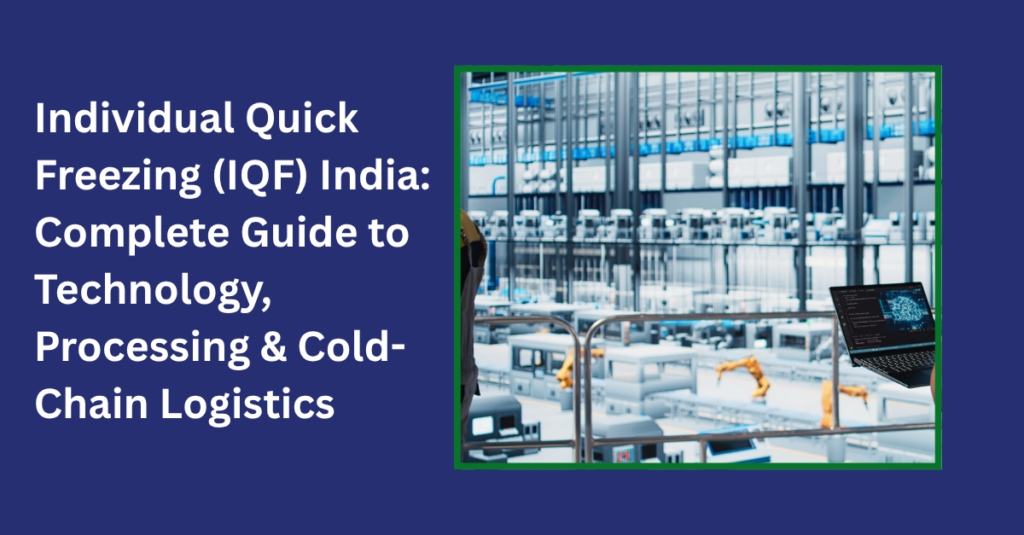
Individual quick freezing IQF India is a rapid freezing method that freezes food pieces separately rather than as a single block. By reducing freezing time and controlling ice-crystal formation, IQF helps preserve the texture, appearance, portionability, and usability of foods. Its benefits depend on proper processing, packaging, storage, and cold-chain distribution.
Individual quick freezing IQF India is a food-processing method in which individual pieces are rapidly frozen and kept separate, helping food brands maintain product quality and convenient portioning. As India’s frozen-food sector expands, IQF technology is becoming increasingly relevant from processing to distribution. But what happens after freezing matters just as much, and that is where the cold chain becomes essential.
What Is Individual Quick Freezing (IQF)?
Individual Quick Freezing, commonly called IQF, is a freezing technique designed to freeze individual food pieces quickly and separately. Unlike block freezing, where products can freeze together into one mass, IQF allows pieces such as peas, vegetables, fruits, seafood, or prepared food components to remain individually separable.
For food manufacturers, this makes frozen products easier to portion, pack, store and use. A consumer can take only the required quantity instead of thawing an entire block.
The technology is particularly useful for products where appearance, texture, convenience, and portion control influence purchasing decisions.
How Is IQF Different From Conventional Freezing?
The main difference lies in how the product freezes.
With conventional or block freezing, multiple pieces may come into contact and freeze together. IQF systems rapidly remove heat from individual pieces, helping them freeze separately.
This can offer practical advantages such as:
- Easier portion control
- Individual piece separation
- Convenient handling
- Consistent presentation
- Reduced need to thaw an entire batch
- Greater flexibility for foodservice and retail applications
However, IQF does not automatically guarantee superior quality. Raw material quality, pre-processing, freezing conditions, packaging, storage, and transportation all influence the final product.
How Does Individual Quick Freezing Work?
The IQF process begins well before the food enters the freezer. Product preparation and handling determine how effectively individual pieces can be frozen.
1. Preparation and Pre-Treatment
Food is cleaned, sorted, cut, or portioned according to the product requirement. Some vegetables may undergo blanching or other pre-treatment before freezing.
Uniformity is important because pieces with significantly different sizes or shapes may freeze at different rates.
2. Rapid Freezing
The prepared food enters an IQF freezing system where cold air or another controlled freezing medium rapidly removes heat from the product.
In fluidized-bed systems, high-velocity air can suspend smaller food pieces, allowing cold air to circulate them. This creates efficient heat transfer and helps freeze pieces individually.
3. Individual Freezing
The objective is to freeze each piece quickly enough to limit the formation of large ice crystals within the food structure. The exact freezing conditions depend on the product, size, moisture content, and equipment.
4. Packaging and Frozen Storage
After freezing, products are packaged and transferred to suitable frozen storage. Maintaining appropriate conditions at this stage is essential because temperature fluctuations can affect product quality.
5. Distribution
The frozen product then moves through the supply chain to warehouses, distribution centres, retailers, restaurants, or other customers.
This final stage is often overlooked. A well-controlled freezing process can still be undermined by poor storage or transportation conditions.
The Science Behind IQF Technology
The effectiveness of IQF technology is closely connected to the speed and consistency of heat removal.
When food freezes, water inside the product forms ice crystals. Slower freezing can encourage the formation of larger crystals, which may affect the food’s structure and texture after thawing.
Rapid freezing aims to create smaller ice crystals and minimise structural disruption.
Airflow, product thickness, temperature, moisture, belt speed and equipment design can all influence freezing performance. This is why there is no universal IQF setting that works identically for every food product.
A food processor must consider the characteristics of the specific product when selecting and operating freezing equipment.
What Foods Can Be Individually Quick Frozen?
IQF is used across a wide range of food categories.
IQF Fruits and Vegetables
Common applications include peas, corn, beans, carrots, berries, mango pieces, pineapple and other cut fruits and vegetables.
Meat, Poultry and Seafood
Individual freezing can also be applied to selected meat, poultry and seafood products, depending on their size, shape and processing requirements.
Ready-to-Cook and Prepared Foods
Frozen snacks, fries, meal components and other prepared foods can benefit from individual portioning and convenient handling.
Herbs and Ingredients
IQF can also be useful for ingredients that food manufacturers or commercial kitchens need to dispense in controlled quantities.
The suitability of a product depends on its physical characteristics and the freezing system being used.
Key Benefits of IQF Frozen Food Processing
For modern food manufacturers, IQF frozen food processing offers advantages that extend beyond simply lowering product temperature.
Better Product Quality
Rapid and controlled freezing can help preserve important characteristics such as appearance and texture.
Individual Piece Separation
Products remain easier to separate and portion, improving convenience for both businesses and consumers.
Convenient Portion Control
Restaurants, QSRs, foodservice operators and consumers can use only the quantity required.
Reduced Product Handling
Individually frozen products can simplify storage, picking and preparation compared with products frozen into large blocks.
Greater Product Flexibility
Frozen ingredients can be incorporated into different recipes, meal formats and foodservice applications.
Wider Distribution Potential
Frozen products can be distributed through temperature-controlled supply chains, allowing brands to serve customers beyond the immediate production area.
IQF Technology Guide: Choosing the Right Freezing System
There is no single freezing system suitable for every product or production environment.
Fluidized-Bed IQF Systems
These systems use controlled airflow to suspend smaller individual pieces while rapidly freezing them. They can be particularly useful for appropriately sized fruits, vegetables and other small products.
Tunnel Freezers
Tunnel systems move products through a controlled freezing environment and can be designed for different production requirements.
Spiral Freezing Systems
Spiral systems can support continuous production while making efficient use of vertical space. Their suitability depends on the product and required production capacity.
Batch vs Continuous Freezing
Batch systems can provide flexibility for certain production environments, while continuous systems may be more appropriate for consistent, higher-volume operations.
The right choice depends on product characteristics, throughput, available space, energy considerations, automation and the manufacturer’s operating requirements.
Why Quick Freezing Matters for Food Brands in India
For growing food brands, quick freezing for food brands is not only a production decision. It can influence how products are packaged, stored, distributed and ultimately experienced by customers.
Frozen foods may travel from a processing facility to a cold store, distribution centre and multiple outlets before reaching the end consumer.
That makes supply-chain consistency critical.
A food brand therefore needs to think beyond the freezer. Packaging must be appropriate for frozen distribution, storage must maintain suitable conditions, and transportation must protect the product throughout the journey.
IQF Food Processing in India: What Businesses Should Consider
Businesses evaluating IQF should consider several factors before investing in or scaling a freezing operation.
- Product characteristics: Size, shape, moisture content, and density affect freezing behaviour.
- Production capacity: Equipment should align with current production as well as realistic future demand.
- Packaging: Packaging should protect the frozen product during storage and transportation.
- Cold storage: Finished products require appropriate frozen storage conditions until dispatch.
- Food safety: Hygiene, handling procedures, and relevant food-safety practices need to be integrated across processing and distribution.
- Distribution: The frozen supply chain should be planned from the processing facility to the final delivery point rather than treated as a separate activity.
The Importance of Cold Chain After IQF Processing
IQF protects food during the freezing stage. The cold chain helps protect that product after freezing.
Once an IQF product leaves the processing facility, it may pass through several points before reaching its destination. Temperature-controlled storage and transportation help maintain the required conditions during this movement.
For food brands, this can involve:
IQF plant → frozen storage → distribution centre → refrigerated vehicle → restaurant, retailer or other destination
JustDeliveries specialises in B2B F&B logistics, including frozen, chilled and ambient transportation, as well as cold storage, warehousing and 3PL solutions. Its technology platform provides real-time tracking, temperature monitoring, proof of delivery and reporting capabilities.
This is particularly relevant for brands distributing frozen products across multiple locations, where visibility and consistent execution become increasingly important.
How JustDeliveries Supports Frozen Food Brands
JustDeliveries provides logistics solutions specifically for the F&B industry, serving food brands, restaurants, QSRs, cloud kitchens and distributors. Its services include specialised frozen-food transportation, temperature-controlled transportation, cold storage, warehousing and intercity logistics.
Its technology-led approach also provides businesses with shipment visibility and temperature information through its tracking platform. The company states that its control-tower model supports centralised management of temperature-sensitive products and faster response to operational disruptions.
For businesses scaling frozen products, this can make logistics a more structured part of the supply chain rather than an afterthought.
The article is authored by Mansi Mahansaria, whose recent JustDeliveries content also covers cold storage and blast freezing for Indian food processors and exporters, reinforcing the brand’s focus on temperature-sensitive F&B supply chains.
Common Challenges in IQF Frozen Food Distribution
Even an effective freezing process can face challenges during distribution.
Temperature Fluctuations
Repeated exposure to unsuitable temperatures can affect frozen product quality.
Delayed Deliveries
Longer transit times can complicate inventory planning and outlet replenishment.
Limited Shipment Visibility
Without tracking, businesses may have difficulty knowing where a shipment is or identifying delays quickly.
Multiple Delivery Points
Brands supplying several outlets need coordinated routing, documentation, and delivery management.
Reverse Logistics
Returns, rejected shipments and expired inventory require a structured reverse-logistics process.
A specialised logistics partner can help businesses manage these operational requirements alongside their core food-processing activities.
Conclusion: Connecting IQF Processing With Reliable Distribution
Individual quick freezing IQF India is an important technology for producing convenient, portionable frozen foods while supporting the preservation of key product characteristics. But freezing is only one stage of the journey.
The real value of IQF comes when processing, packaging, storage and distribution work together. For food brands expanding across cities and serving multiple outlets, maintaining control after the product leaves the freezer is just as important as the freezing process itself.
Keep Your Frozen Products Moving With JustDeliveries
If your food brand is scaling IQF or other frozen products, reliable logistics can help connect your processing facility with warehouses, distribution centres, restaurants and retail destinations.
JustDeliveries provides F&B-focused cold-chain logistics, frozen-food transportation, cold storage, technology-enabled tracking and supply-chain visibility to help businesses manage temperature-sensitive deliveries.
Partner with JustDeliveries to build a more reliable frozen-food supply chain. Explore JustDeliveries and discuss your logistics requirements today.
Frequently Asked Questions
Q1. How does IQF freezing work?
IQF rapidly removes heat from individual food pieces so they freeze separately. The process generally involves preparation, rapid freezing, packaging, and controlled frozen storage.
Q2. Can IQF be used for fruits and vegetables?
Yes. IQF is widely suited to appropriately prepared fruits and vegetables, including products such as peas, corn, beans and cut fruit. Suitability depends on product characteristics and processing requirements.
Q3. Is IQF better than conventional freezing?
IQF can offer advantages such as individual piece separation and portion control. However, the best freezing method depends on the product, equipment, production volume, and desired outcome.
Q4. Will IQF prevent food quality changes completely?
No. IQF can help preserve important quality characteristics, but final quality also depends on raw materials, processing, packaging, storage, and temperature-controlled distribution.
Q5. What does IQF stand for?
IQF stands for Individual Quick Freezing. It refers to a process where individual food pieces are rapidly frozen separately.
Q6. Why is cold-chain logistics important for IQF food?
Cold-chain logistics helps maintain suitable conditions after freezing. Proper storage and temperature-controlled transportation are essential for protecting frozen products during distribution.
Q7. How should IQF frozen food be transported?
IQF frozen food should be transported using suitable temperature-controlled vehicles and handled according to the product’s required conditions. Monitoring and timely delivery also help maintain supply-chain control.
Q8. Can JustDeliveries help with frozen food distribution?
Yes. JustDeliveries provides B2B F&B logistics solutions that include frozen-food transportation, cold storage, warehousing, tracking, temperature monitoring and intercity logistics.

Mansi Mahansaria
I’m Mansi Mahansaria, CEO and Founder of JustDeliveries, a B2B logistics company specializing in the food and beverage sector. With a background in Chemical Technology (ICT Mumbai), an MBA (FMS Delhi), and experience at IDFC Private Equity and Tata Group, I’ve built a plug-and-play logistics network helping F&B brands scale efficiently. I also share insights on entrepreneurship and logistics at industry and academic events.