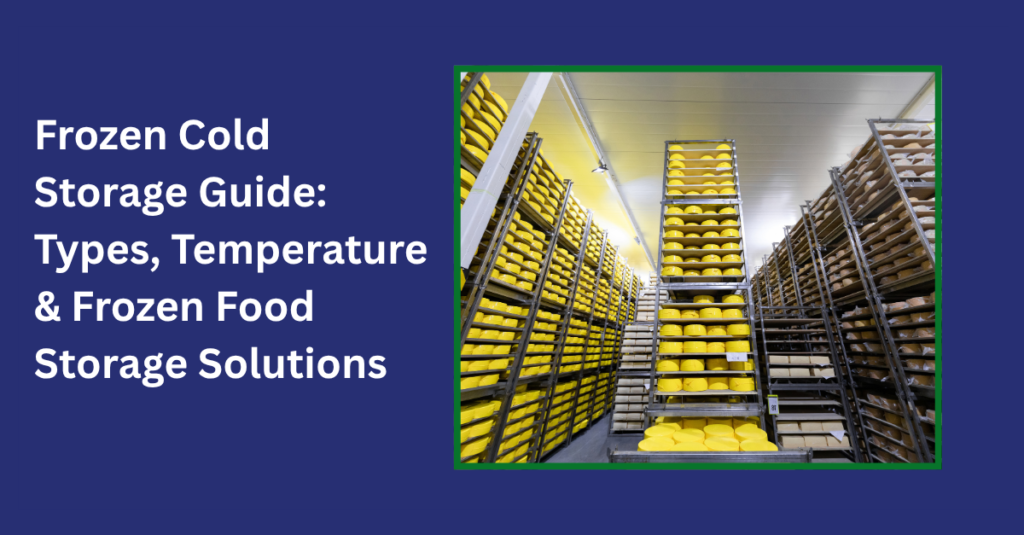
A frozen cold storage guide explains how frozen products are stored, monitored, and moved under controlled temperatures to preserve quality and safety. For many frozen foods, -18°C is a commonly used storage benchmark. Effective frozen storage combines reliable refrigeration, insulation, monitoring, inventory control, and temperature-controlled transportation.
A frozen cold storage guide helps businesses understand how to store frozen food safely and consistently from warehouse to delivery. The right temperature, infrastructure, and monitoring protect product quality across the cold chain. For F&B businesses seeking integrated frozen storage and logistics support, JustDeliveries provides warehousing and temperature-controlled logistics solutions. The real challenge is keeping that temperature consistent at every handover.
What Is Frozen Cold Storage?
Frozen cold storage is a temperature-controlled environment designed to keep frozen products at the required temperature throughout storage. Unlike ordinary warehousing, it relies on refrigeration, insulation, controlled airflow, and temperature monitoring to create stable conditions for temperature-sensitive inventory.
Frozen storage is an important part of the wider cold chain. A product may begin at a manufacturing facility, move into a cold warehouse, travel in a refrigerated vehicle and eventually reach a restaurant, retailer or customer. If temperature control is inconsistent at any stage, product quality can be affected.
For food businesses, therefore, frozen storage is not simply about having a freezer. It is about creating a reliable system for storage, inventory handling, monitoring, and distribution.
What Temperature Is Required for Frozen Cold Storage?
For many frozen food applications, -18°C is a widely used storage benchmark. JustDeliveries’ frozen storage offering is maintained at -18°C and is positioned for products including ice cream, frozen food, meat and seafood.
However, businesses should always follow the storage temperature specified for their particular product, packaging, and supply-chain requirements. Not every frozen product has identical handling needs.
Why Is -18°C Cold Storage Important?
Maintaining a stable low temperature helps frozen products remain in their intended frozen state during storage. Temperature stability is particularly important for products that can be sensitive to melting, refreezing, texture changes, or prolonged exposure to unsuitable conditions.
A useful distinction is:
- Frozen storage: commonly around -18°C for many frozen products
- Chilled storage: typically used for products requiring temperatures above freezing
- Deep-freeze or specialised storage: may require lower temperatures depending on the product
JustDeliveries, for example, lists frozen storage at -18°C and chilled storage between 2°C and 8°C as separate storage options.
What Products Need Frozen Food Storage Solutions?
Frozen food storage solutions are relevant to a wide range of F&B businesses.
Frozen Foods
Ready-to-cook foods, frozen snacks, prepared meals and other frozen products need controlled storage to maintain their required condition between production and distribution.
Ice Cream and Frozen Desserts
Ice cream is particularly temperature-sensitive. Reliable frozen storage helps businesses manage inventory before it is dispatched to stores, outlets or other distribution points.
Meat and Seafood
Frozen meat and seafood require controlled conditions throughout storage and transportation. Temperature monitoring becomes especially important when products move through multiple supply-chain stages.
Other Frozen F&B Products
Food manufacturers, distributors, restaurants, QSRs and cloud kitchens may also require frozen storage depending on their menu, inventory model and distribution network.
JustDeliveries specifically works with F&B categories including ice creams, meats, frozen snacks and other perishables.
What Are the Main Frozen Food Storage Solutions?
Businesses can choose different storage models depending on inventory volume, location, and operational requirements.
Frozen Cold Rooms
Cold rooms provide a controlled environment for storing temperature-sensitive products. They can be suitable for businesses that require dedicated frozen inventory space.
Frozen Storage Warehouses
Larger warehouses allow businesses to hold greater volumes of inventory and organise stock for regular distribution. This can be particularly useful for manufacturers, distributors and expanding F&B brands.
3PL Frozen Warehousing
A third-party logistics provider can manage storage and related warehouse operations on behalf of a business. This approach can help growing brands access infrastructure without building and managing their own complete logistics network.
JustDeliveries describes itself as an F&B-focused 3PL partner and provides warehousing, cold storage, and logistics services designed around food businesses. Its facilities use temperature control, and its warehouse operations include inventory visibility and monitoring.
What Is Frozen Warehousing in India?
Frozen warehousing India refers to temperature-controlled warehouse infrastructure used to store frozen products within the Indian food supply chain.
India’s F&B market includes manufacturers, QSRs, restaurants, cloud kitchens, food brands, and distributors operating across multiple cities. As businesses expand, they may need storage closer to their customers or outlets rather than relying on a single central facility.
A well-managed frozen warehouse can support:
- Regional inventory holding
- Faster replenishment
- Multi-city expansion
- Better stock organisation
- Temperature-controlled dispatch
- Integration with transportation
- Scalable logistics operations
For businesses that do not want to invest heavily in their own fleet and infrastructure, a 3PL model can provide a more flexible way to scale. JustDeliveries positions its services around plug-and-play logistics and storage for F&B brands.
What Are the Key Components of Frozen Cold Storage?
A reliable frozen storage facility depends on more than refrigeration equipment.
Refrigeration
The refrigeration system maintains the required temperature and must be appropriately designed for the facility’s storage capacity and operating conditions.
Insulation
Effective insulation helps minimise heat transfer between the storage environment and the surrounding area. Doors, walls, floors and ceilings all play a role.
Temperature Monitoring
Continuous monitoring helps businesses identify temperature deviations quickly. JustDeliveries states that it provides real-time temperature monitoring and alerts for deviations within its warehouse operations.
Inventory Management
Frozen products need organised inventory control. Accurate stock visibility helps businesses know what is available, what needs dispatch, and what is approaching expiry.
Storage and Handling
Palletisation, appropriate racking, controlled loading and unloading, and efficient movement inside the facility can all contribute to smoother operations.
How Should Frozen Food Be Stored in a Cold Storage Warehouse?
A practical frozen-storage process generally follows these steps:
- Receive the products: Check incoming inventory and relevant product information.
- Verify temperature: Confirm that products arrive within their required temperature range.
- Move products into controlled storage: Minimise unnecessary exposure to ambient conditions.
- Organise inventory: Store products systematically so stock can be located and dispatched efficiently.
- Monitor continuously: Use temperature monitoring to identify deviations.
- Follow appropriate stock rotation: FEFO, or First Expiry, First Out, can help businesses prioritise products based on expiry dates.
- Prepare orders efficiently: Reduce the time products spend outside controlled conditions during picking and staging.
- Dispatch through temperature-controlled transport: Maintain cold-chain continuity after the product leaves the warehouse.
JustDeliveries states that its warehouse operations use FEFO, real-time stock tracking through a Warehouse Management System and temperature alerts.
Why Does Temperature Monitoring Matter?
A frozen warehouse can maintain the right set point, but businesses also need visibility into what is happening operationally.
Temperature monitoring helps teams:
- Identify deviations
- Respond faster to potential issues
- Maintain temperature records
- Improve accountability
- Monitor storage conditions
- Support operational reporting
This becomes even more important when products move from warehouse to vehicle and then to their destination.
JustDeliveries’ technology platform includes real-time tracking, temperature monitoring, proof of delivery, analytics and reports, giving businesses greater visibility across their logistics operations.
Frozen Cold Storage vs Frozen Food Transportation
Frozen storage and frozen transportation perform different roles, but they need to work together.
| Frozen Cold Storage | Frozen Food Transportation |
| Stores frozen inventory | Moves frozen inventory |
| Uses a controlled warehouse environment | Uses temperature-controlled vehicles |
| Focuses on inventory holding | Focuses on transit |
| Requires refrigeration and monitoring | Requires vehicle temperature control and tracking |
| Supports order fulfilment | Supports distribution |
The cold chain does not end when a product leaves the warehouse. The transition from storage → loading → transportation → unloading → destination must be managed carefully.
JustDeliveries provides both cold-storage/warehouse management and specialised frozen-food transportation, allowing F&B businesses to connect storage with distribution.
How Do You Choose the Right Frozen Cold Storage Solution?
Before selecting a facility or 3PL partner, consider:
- Required storage temperature
- Product category
- Storage volume
- Warehouse location
- Inventory turnover
- Temperature monitoring
- Stock visibility
- Loading and unloading processes
- Transportation availability
- Scalability
- Reporting requirements
- Reverse logistics capabilities
The right solution should fit the way your business actually operates rather than simply offering freezer space.
For example, a growing ice cream brand may need reliable frozen storage, frequent replenishment, temperature-controlled vehicles, and visibility across multiple outlets. A manufacturer distributing large volumes may have very different pallet and warehouse requirements.
Why Choose a 3PL for Frozen Warehousing and Logistics?
Managing frozen logistics internally can involve multiple operational responsibilities, including warehouse infrastructure, inventory handling, vehicles, drivers, route planning, monitoring and reporting.
A specialised 3PL can bring these functions together.
This can be useful for:
- Growing food brands
- Ice cream businesses
- QSR chains
- Cloud kitchens
- Restaurants
- Frozen food manufacturers
- Food distributors
- Businesses expanding into new cities
JustDeliveries focuses exclusively on the F&B industry and combines cold-chain and dry logistics with technology-enabled operations and on-ground execution. Its services are designed for restaurants, QSRs, cloud kitchens, food brands, and distributors.
Build a More Reliable Frozen Cold Chain with JustDeliveries
Frozen storage works best when warehousing and transportation are treated as one connected supply chain. The right infrastructure can help businesses maintain temperature control, improve inventory visibility, and move frozen products more efficiently.
At JustDeliveries, Mansi Mahansaria, Founder & CEO, leads an F&B-focused logistics company built around temperature-controlled transportation, warehousing, and technology-enabled supply-chain operations.
If your business needs dependable frozen warehousing, -18°C storage or temperature-controlled distribution, explore JustDeliveries’ Warehousing & Cold Storage Solutions and speak with the team about your storage and logistics requirements.
Ready to simplify your frozen supply chain? Get in touch with JustDeliveries and find a storage and logistics solution built around your F&B business.
Frequently Asked Questions
Q1. What is frozen cold storage?
Frozen cold storage is a temperature-controlled facility used to keep frozen products at their required temperature during storage. It combines refrigeration, insulation, monitoring and organised inventory handling.
Q2. How cold should frozen food storage be?
For many frozen food applications, -18°C is a commonly used benchmark. However, businesses should follow the specific storage requirements of each product.
Q3. Can frozen food be stored at -18°C?
Yes. -18°C cold storage is commonly used for many frozen food products. The exact requirement should always be confirmed against the product’s specifications and applicable handling standards.
Q4. Is frozen warehousing different from cold storage?
Frozen warehousing is a type of cold storage specifically designed for frozen products. Cold storage is a broader term that can also include chilled storage and other temperature-controlled environments.
Q5. What are frozen food storage solutions?
Frozen food storage solutions include frozen cold rooms, temperature-controlled warehouses, and 3PL frozen warehousing designed to store frozen products under controlled conditions.
Q6. Will temperature monitoring improve frozen storage operations?
Yes. Continuous monitoring can provide visibility into storage conditions and help teams identify temperature deviations promptly, supporting more consistent cold-chain operations.
Q7. Why is frozen transportation important after storage?
Frozen transportation maintains temperature control after products leave the warehouse. Without controlled transit, the cold chain can be interrupted even when warehouse storage has been properly managed.
Q8. What should businesses look for in frozen warehousing India?
Businesses should evaluate temperature control, capacity, location, inventory visibility, monitoring, handling processes, scalability, and access to reliable frozen transportation.

Mansi Mahansaria
I’m Mansi Mahansaria, CEO and Founder of JustDeliveries, a B2B logistics company specializing in the food and beverage sector. With a background in Chemical Technology (ICT Mumbai), an MBA (FMS Delhi), and experience at IDFC Private Equity and Tata Group, I’ve built a plug-and-play logistics network helping F&B brands scale efficiently. I also share insights on entrepreneurship and logistics at industry and academic events.