
Blog
B2B Food Delivery in India: How It Works, Benefits, Costs & Best Solutions
15 October 2026By Abhishek Kumar
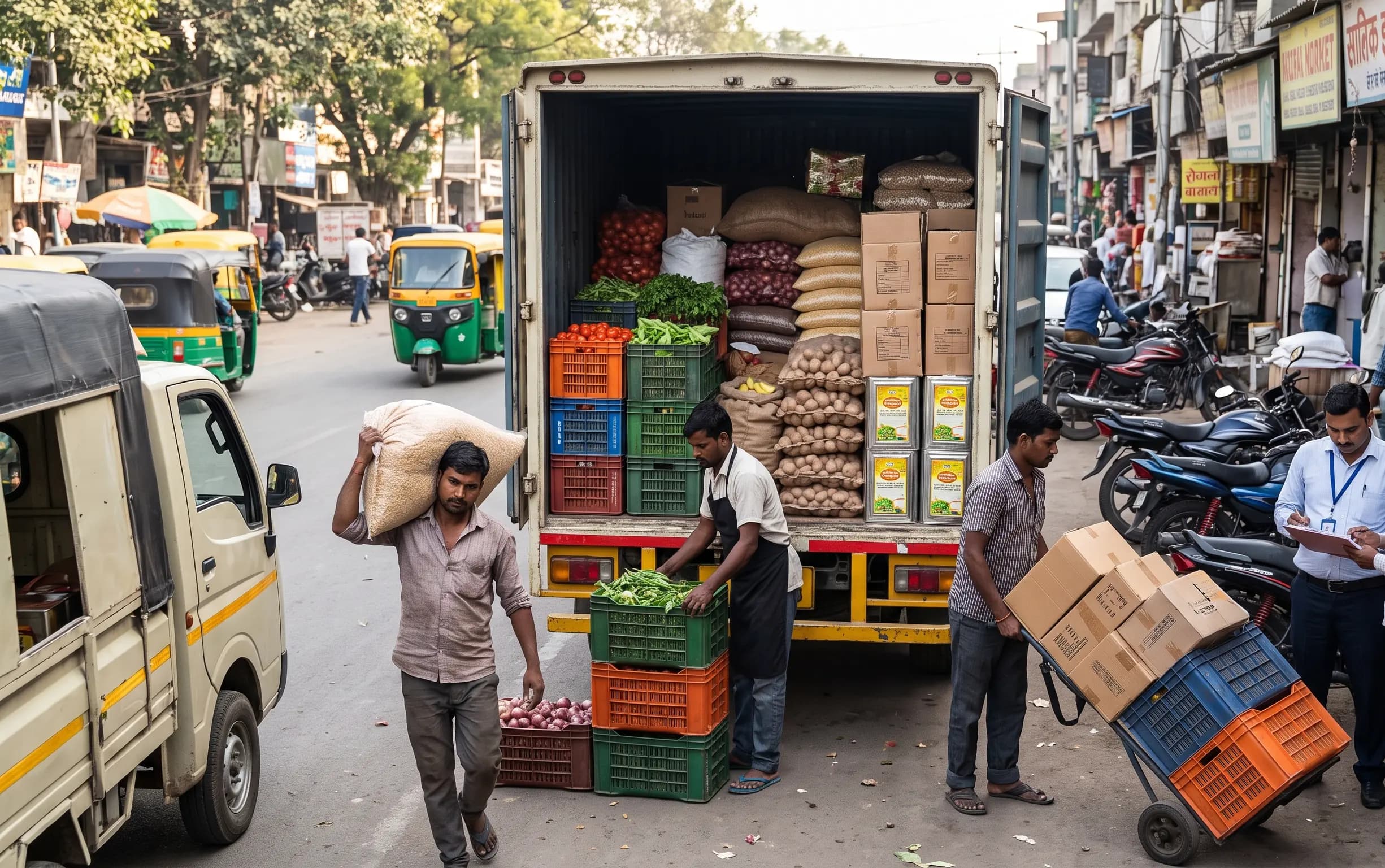
B2B food delivery in India is the movement of food, ingredients, beverages and other F&B products between businesses rather than individual consumers. It supports restaurants, hotels, cafés, caterers, QSRs and food brands through scheduled deliveries, dedicated vehicles, cold-chain transportation, warehousing and technology-enabled supply-chain operations.
B2B food delivery in India helps restaurants, cafés, hotels, caterers, QSRs and food brands move products reliably between kitchens, warehouses, outlets, hubs and stores. Unlike consumer delivery, it focuses on recurring business requirements, bulk movement and temperature-sensitive logistics. JustDeliveries provides dedicated vehicles, cold-chain transportation and technology-led logistics for growing F&B businesses.
The real difference lies in what happens behind the order.
What Is B2B Food Delivery?
B2B food delivery refers to the transportation of food and F&B products from one business location to another. A supplier may deliver ingredients to a restaurant, a central kitchen may distribute prepared food to multiple outlets, or a food brand may replenish inventory at quick-commerce hubs and dark stores.
A typical B2B food delivery network can involve:
- Suppliers and manufacturers
- Central kitchens
- Warehouses and cold stores
- Restaurants and QSR outlets
- Hotels and cafés
- Caterers
- Retail stores
- Quick-commerce hubs and dark stores
The process is usually planned around delivery schedules, order volumes, vehicle requirements and product temperature. This makes B2B logistics considerably more operational than a simple point-to-point delivery.
How Does B2B Food Delivery Work for Restaurants in India?
The process generally follows a connected supply-chain cycle:
- Order planning: The business determines its inventory and replenishment requirements.
- Pickup: Products are collected from suppliers, warehouses or central kitchens.
- Temperature-controlled transportation: Chilled, frozen or ambient products travel in vehicles suited to their requirements.
- Outlet delivery: Products reach restaurants, cafés, hotels or other business locations according to planned delivery windows.
- Tracking and proof of delivery: Businesses can monitor vehicle movement, delivery status and documentation.
For temperature-sensitive products, maintaining the right conditions throughout the journey is particularly important. JustDeliveries operates temperature-controlled logistics across a range of F&B categories, with a stated operating range of −18°C to +18°C depending on requirements. For a closer look at handling, read about perishable goods transportation.
B2B vs B2C Food Delivery in India
The difference between B2B vs B2C food delivery in India starts with the customer and extends to the entire delivery model.
B2B delivery is designed for businesses moving products through their supply chain. B2C delivery generally involves a restaurant or retailer sending an individual order directly to a consumer.
Key Differences
B2B food delivery:
- Larger and recurring orders
- Scheduled deliveries
- Multiple delivery points
- Dedicated or temperature-controlled vehicles
- Business-focused documentation
- Contract or negotiated pricing
- Greater emphasis on supply-chain reliability
B2C food delivery:
- Individual consumer orders
- On-demand delivery
- Smaller shipments
- Short delivery windows
- Consumer-facing ordering platforms
- Greater emphasis on convenience and speed
For an F&B business operating multiple locations, B2B logistics can become part of the core operating infrastructure rather than simply another delivery expense.
Food Delivery for Hotels and Cafés in India
The requirements for food delivery for hotels and cafes in India can vary significantly from standard consumer delivery.
Hotels may need ingredients, dairy, frozen products, beverages and prepared food to move between suppliers, central kitchens, storage facilities and properties. Café chains may require early-morning replenishment of bakery products, dairy, fresh ingredients and other temperature-sensitive supplies.
For growing café and restaurant chains, consistency becomes particularly important. A reliable logistics network can help maintain:
- Consistent delivery schedules
- Product freshness
- Temperature compliance
- Outlet-level replenishment
- Multi-location distribution
- Better supply-chain visibility
JustDeliveries works with F&B businesses across categories including cafés, QSRs, bakeries, frozen foods, fresh produce, meat and poultry, seafood, confectionery and ready-to-eat products.
Wholesale Food Delivery for Businesses in India
Wholesale food delivery for businesses in India involves moving larger quantities of food products between suppliers, manufacturers, distributors, warehouses and commercial buyers.
However, wholesale movement is not simply about transporting more products. Businesses also need the right infrastructure for handling different product categories.
Common products include:
- Frozen foods
- Dairy
- Fresh fruits and vegetables
- Meat and poultry
- Seafood
- Bakery products
- Beverages
- Chocolates and confectionery
- Ready-to-eat foods
For perishable products, cold-chain continuity is essential. A temperature-controlled vehicle, appropriate handling procedures and real-time visibility can help businesses maintain product integrity throughout transportation. For frozen items in particular, see frozen food transportation india.
Why Businesses Use B2B Food Delivery Services
A well-managed B2B logistics system can simplify several operational challenges.
Predictable Delivery Operations
Recurring routes and planned delivery schedules make it easier for businesses to coordinate inventory and outlet requirements.
Dedicated Vehicles and Drivers
Businesses with regular volumes can use dedicated vehicles and drivers instead of arranging transportation for every trip. JustDeliveries’ JD Regular service provides dedicated drivers and vehicles under annual contracts, alongside account management and a 24/7 control tower.
Better Cold-Chain Management
Refrigerated transportation helps businesses move chilled and frozen products under controlled conditions. For outlets in Bangalore, see frozen food transport bangalore.
Easier Multi-Outlet Distribution
A structured logistics network can support businesses supplying several outlets, hubs or stores from a central facility. For city-level coverage in the north, see cold chain logistics delhi.
Greater Operational Visibility
Digital tracking gives businesses better visibility into vehicle movement, temperature compliance, delivery status and operational performance.
How Much Does B2B Food Delivery Cost in India?
There is no single price for B2B food delivery in India because logistics requirements differ from one business to another.
The main cost factors include:
- Vehicle type and capacity
- Delivery distance
- Number of stops
- Delivery frequency
- Temperature requirements
- Operating hours
- Number of outlets
- Route complexity
- Storage requirements
- Contract duration
A business with daily deliveries across several outlets may require a dedicated vehicle, while another business may benefit from on-demand refrigerated transportation.
JustDeliveries offers both scheduled dedicated logistics and on-demand refrigerated vehicle solutions. Its JD Instant model allows businesses to book chilled or frozen vehicles when required and pay for the trips they use.
Dedicated vs On-Demand B2B Food Delivery
The right model depends on the business’s delivery pattern.
Dedicated logistics can work well for:
- Daily recurring routes
- High-volume F&B businesses
- Restaurant and QSR chains
- Multi-outlet operations
- Predictable delivery schedules
On-demand logistics can suit:
- Urgent replenishment
- Unplanned deliveries
- Short-term requirements
- Additional seasonal demand
- Businesses testing new routes
Choosing between the two becomes easier when businesses understand their average volume, delivery frequency and temperature-control requirements.
How Cold-Chain Logistics Supports B2B Food Delivery
Cold-chain logistics is an important part of B2B food delivery in India, particularly for products that require controlled temperatures.
The cold chain can include:
Cold storage → order processing → refrigerated transportation → hub or outlet → final business handover
Products such as ice cream, frozen foods, dairy, seafood, meat, fresh desserts and certain ready-to-eat products need suitable temperature management during transportation.
JustDeliveries provides temperature-controlled transportation, cold storage and 3PL services for F&B businesses. Its wider network combines warehousing, inventory management and transportation to create an integrated cold-chain operation.
Technology Makes Cold-Chain Visibility Stronger
JustDeliveries’ HQ App provides F&B brands with a central dashboard for live vehicle tracking, temperature compliance, SLA monitoring, billing and AI-driven performance insights. This gives businesses real-time operational visibility rather than relying solely on manual updates.
How Quick Commerce Is Changing B2B Food Logistics
Quick commerce has changed the expectations around replenishment speed. Products increasingly need to move efficiently from warehouses and hubs to dark stores while maintaining temperature integrity. For more on this channel, read about q commerce delivery.
JustDeliveries powers cold-chain logistics for Swiggy Instamart, Zepto, Blinkit, Amazon, JioMart and BigBasket, handling hub-to-hub and dark-store deliveries with real-time tracking and temperature-controlled operations.
This creates a different logistics requirement from traditional retail distribution. A food brand supplying quick commerce may need:
- Appointment-based replenishment
- Faster hub-to-hub movement
- Temperature-controlled transportation
- Real-time shipment visibility
- Dark-store delivery
- Inventory coordination
- Reliable delivery windows
As quick commerce expands, cold-chain logistics becomes an increasingly important part of the infrastructure supporting these channels.
How to Choose a B2B Food Delivery Company in India
When evaluating a logistics partner, businesses should look beyond the delivery price. For delivery-cost guidance, see this last mile delivery partner resource.
Consider:
Industry Experience
F&B logistics involves different requirements from general cargo. The provider should understand perishables, food handling and delivery schedules.
Vehicle Capabilities
Check whether the fleet supports refrigerated, frozen and ambient requirements.
Temperature Monitoring
Temperature-sensitive products need appropriate monitoring throughout transportation.
Tracking and Proof of Delivery
Real-time tracking and digital PODs can improve visibility and accountability.
Geographic Coverage
Businesses expanding across cities should consider whether the provider can support their future distribution network.
Warehousing and 3PL
A partner that can combine storage, inventory management and transportation may simplify the overall supply chain.
JustDeliveries currently operates across major markets including Mumbai, Bengaluru, Delhi NCR, Pune, Hyderabad and Chennai, with a broader pan-India F&B logistics network. For outlets in the south, see cold chain logistics hyderabad.
Best B2B Food Delivery Company for Caterers in India: What Should You Look For?
Instead of choosing a provider solely on price, caterers should assess whether the logistics model matches their operational requirements.
The right logistics partner should be able to support:
- Bulk food movement
- Scheduled deliveries
- Temperature-controlled transportation
- Flexible vehicle requirements
- Reliable delivery windows
- Multiple destinations
- Real-time tracking
- Proof of delivery
- Emergency or additional trips
JustDeliveries supports corporate catering and other F&B businesses through dedicated logistics, temperature-controlled transportation, and operational visibility. See the corporate catering logistics case study led by Mansi Mahansaria, Founder & CEO of JustDeliveries.
Why JustDeliveries for B2B Food Logistics?
B2B food delivery in India works best when transportation, temperature control and visibility operate as one connected system.
JustDeliveries is built specifically around F&B logistics, supporting businesses with:
- Dedicated drivers and vehicles
- Intra-city logistics
- Inter-city cold-chain movement
- Refrigerated transportation
- Warehousing and 3PL
- Quick-commerce fulfilment
- Dark-store replenishment
- Real-time vehicle tracking
- Temperature monitoring
- Digital proof of delivery
- Technology-enabled supply-chain visibility
The company currently states that more than 150 F&B brands use its services, supported by hundreds of vehicles and a 24/7 control tower.
Its operational approach is led by F&B logistics expertise, with Mansi Mahansaria as Founder & CEO and the company focused specifically on temperature-controlled movement and supply-chain infrastructure for food businesses.
Key Takeaways
B2B food logistics is fundamentally different from consumer food delivery. It is designed around the movement of food between businesses, with greater emphasis on volume, scheduling, temperature control and operational visibility.
For restaurants, cafés, hotels, caterers, QSRs and food brands, the right logistics model can support:
- Reliable replenishment
- Better cold-chain control
- Multi-outlet distribution
- Quick-commerce fulfilment
- Real-time visibility
- Scalable operations
The best model depends on the products being transported, delivery frequency, number of locations, and temperature requirements.
Move Your F&B Logistics Forward with JustDeliveries
Your food supply chain should be as dependable as the business you have built.
Whether you need dedicated vehicles for daily outlet deliveries, refrigerated transportation for perishables, quick-commerce replenishment, or integrated warehousing and 3PL support, JustDeliveries provides F&B-focused logistics designed around temperature, timing and visibility.
From central kitchens and restaurants to warehouses, hubs and dark stores, the focus remains simple: move the right products, at the right temperature, to the right place, at the right time.
Ready to simplify your B2B food logistics? Talk to JustDeliveries for a customised solution built around your routes, volumes and temperature requirements.
Frequently Asked Questions
Q1. Does B2B food delivery work for restaurants in India?
Restaurants receive ingredients, prepared food or inventory from suppliers, warehouses or central kitchens through scheduled or on-demand business deliveries.
Q2. Can hotels and cafés use B2B food delivery services?
Yes. Hotels and cafés can use B2B logistics for ingredients, bakery products, dairy, beverages, frozen foods, and other supplies between business locations.
Q3. Is B2B food delivery different from B2C delivery?
Yes. B2B delivery serves businesses and usually involves larger, recurring or scheduled shipments, while B2C delivery serves individual consumers.
Q4. What products require B2B cold-chain delivery?
Frozen foods, ice cream, dairy, seafood, meat, certain fresh foods, and other temperature-sensitive products can require controlled-temperature transportation.
Q5. Why is temperature control important in B2B food delivery?
Temperature control helps maintain product quality and freshness during transportation and reduces the risk of temperature-related spoilage.
Q6. Will B2B food delivery support multiple restaurant outlets?
Yes. B2B logistics can support recurring deliveries from a central kitchen, warehouse or supplier to multiple restaurant and café outlets.
Q7. Can caterers use dedicated B2B food logistics?
Yes. Caterers can use dedicated or scheduled vehicles for bulk movements, recurring routes, and temperature-sensitive food transportation.
Q8. What should businesses check before choosing a B2B food delivery company?
Businesses should evaluate F&B experience, vehicle capabilities, temperature monitoring, tracking, delivery coverage, warehousing options, pricing and service reliability.