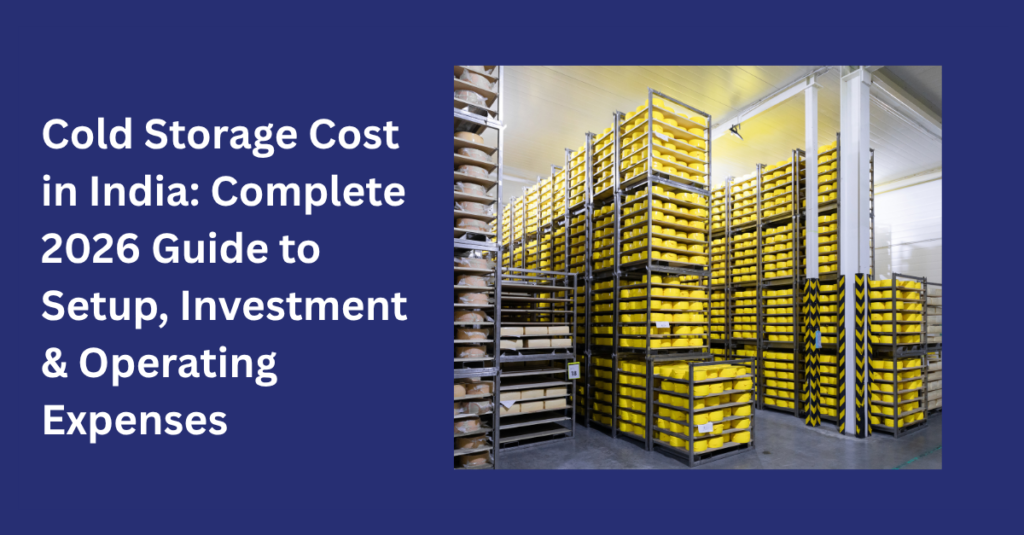
Cold storage cost in India typically ranges from ₹8,000 to ₹25,000 per MT, depending on warehouse size, temperature requirements, automation level, and location. Major expenses include land, refrigeration systems, insulation panels, electricity, and logistics infrastructure. Businesses can reduce long-term costs through energy-efficient systems, integrated cold chain logistics, and shared warehousing models.
Cold storage cost in India depends on factors like storage capacity, refrigeration technology, energy consumption, and logistics integration. As food delivery, frozen foods, dairy, and pharma sectors grow rapidly, businesses increasingly need reliable cold chain infrastructure. This guide by JustDeliveries explores setup costs, operating expenses, profitability, and practical ways to optimize cold storage investments in India.
What is Cold Storage and Why is it Important in India?
Cold storage refers to temperature-controlled facilities designed to preserve perishable products such as dairy, frozen foods, seafood, meat, pharmaceuticals, fruits, and vegetables. These facilities maintain specific temperature ranges to extend shelf life and reduce spoilage during storage and transportation, the mechanics of which are explained in how a cold storage unit works.
India’s cold chain industry has grown significantly over the last decade due to changing consumer habits, urban expansion, online grocery platforms, and the increasing demand for temperature-sensitive products, a shift that begins with understanding what cold storage means and how it works.
Today, industries relying heavily on cold storage include:
- Food & beverage
- Dairy and frozen desserts
- Meat and seafood
- Pharmaceuticals
- Quick-service restaurants (QSRs)
- Agriculture exports
- Cloud kitchens and FMCG brands
Without efficient cold storage infrastructure, businesses face inventory losses, product spoilage, delayed deliveries, and compliance risks. Partnering with the right cold storage suppliers in India helps businesses avoid these operational setbacks and build a more resilient supply chain.
Cold Storage Cost in India — Complete Cost Breakdown
Understanding cold storage cost in India requires looking beyond warehouse construction alone. The total investment includes infrastructure, refrigeration equipment, energy systems, transportation support, and operational technology.
Land Cost
Land pricing varies significantly across India.
- Metro cities have higher industrial land costs.
- Tier-2 cities offer lower setup expenses.
- Agricultural hubs may provide easier access to supply chains.
Businesses must also consider future expansion possibilities while selecting land.
Estimated cost:
- ₹2 crore to ₹20 crore depending on the city and project scale.
Civil Construction Cost
Cold storage construction differs from traditional warehouses because it requires:
- thermal insulation
- moisture-resistant flooring
- vapor barriers
- loading docks
- drainage systems
Construction quality directly affects energy efficiency and long-term operating expenses.
Estimated construction cost:
- ₹1,500 to ₹2,500 per sq. ft.
Refrigeration System Cost
Refrigeration is the backbone of any cold storage facility.
Major components include:
- compressors
- condensers
- evaporators
- cooling units
- control systems
- backup refrigeration
Facilities storing frozen products require more advanced refrigeration systems than chilled warehouses.
Estimated refrigeration cost:
- 35% to 50% of the total project cost
PUF Panel & Insulation Cost
PUF (Polyurethane Foam) panels help maintain stable temperatures and reduce energy loss.
Higher-quality insulation significantly lowers electricity consumption over time.
Estimated cost:
- ₹900 to ₹1,800 per sq. meter
Material Handling & Storage Equipment
Modern cold storage facilities often include:
- pallet racking systems
- forklifts
- dock levelers
- automated handling equipment
Automation improves operational efficiency and minimizes inventory damage.
Electricity & Power Backup Cost
Electricity is one of the largest recurring expenses in cold storage operations.
Facilities require:
- continuous power supply
- diesel generators
- voltage stabilizers
- backup cooling systems
Energy-efficient refrigeration can substantially reduce operating costs over time.
Technology & Monitoring Systems
Modern facilities increasingly use:
- IoT sensors
- real-time temperature monitoring
- warehouse management systems (WMS)
- GPS tracking
- automated alerts
These technologies improve compliance, reduce spoilage, and increase operational visibility. Businesses investing in temperature controlled logistics benefit from this kind of end-to-end monitoring that protects product integrity from warehouse to final delivery.
Average Cold Storage Cost Per MT in India
The average cold storage cost in India varies according to facility size and temperature requirements.
| Capacity | Approximate Cost |
| 500 MT | ₹40 lakh – ₹1 crore |
| 1,000 MT | ₹1 crore – ₹2.5 crore |
| 5,000 MT | ₹5 crore – ₹15 crore |
| 10,000+ MT | ₹20 crore+ |
Multi-temperature facilities generally cost more because they require complex refrigeration zoning and monitoring systems.
Operational Expenses in Running a Cold Storage Facility
Setting up infrastructure is only one part of the investment. Businesses must also manage recurring operational expenses.
Electricity Consumption
Power usage can account for nearly 30–40% of total operating costs.
Factors affecting energy usage:
- insulation quality
- ambient temperature
- warehouse size
- refrigeration efficiency
Manpower & Maintenance
Cold storage facilities require trained technicians, warehouse operators, and maintenance staff.
Regular servicing is necessary for:
- compressors
- evaporators
- refrigeration units
- monitoring systems
Preventive maintenance helps avoid costly downtime.
Transportation & Cold Chain Logistics
Many businesses underestimate the importance of transportation in maintaining product integrity.
A warehouse alone cannot protect perishable products if transportation lacks temperature control.
This is where integrated cold chain logistics become essential. For businesses operating across the capital region, leveraging dedicated cold chain logistics Delhi infrastructure ensures that products maintain the required temperature standards from the point of storage all the way to the end customer, much like dedicated cold chain logistics in Mumbai does for western India.
Key Factors Affecting Cold Storage Cost in India
Several variables directly influence overall investment and operational expenses.
- Storage Temperature: Frozen storage requires lower temperatures and more powerful refrigeration systems than chilled storage.
- Warehouse Capacity: Larger facilities benefit from economies of scale but require higher upfront investment.
- Location: Electricity tariffs, land costs, and logistics connectivity vary across regions. Facilities near urban consumption hubs may reduce transportation expenses.
- Automation Level: Automated facilities improve operational efficiency but increase initial setup cost.
- Product Type: Different products require different humidity and temperature conditions.
For example:
- Seafood storage differs from dairy storage
- Pharmaceuticals require stricter compliance standards
How Businesses Can Reduce Cold Storage Costs
Businesses can reduce long-term expenses through smarter infrastructure planning and efficient logistics management.
Use Energy-Efficient Refrigeration
Modern compressors and smart cooling systems significantly reduce electricity consumption.
Invest in Better Insulation
High-quality insulation lowers temperature fluctuations and reduces compressor load.
Improve Inventory Turnover
Faster inventory movement minimizes storage duration and energy costs.
Use Shared Cold Storage Models
Shared warehousing reduces capital expenditure for growing brands.
This approach works particularly well for:
- startups
- cloud kitchens
- frozen food brands
- regional distributors
Partner with Integrated Cold Chain Providers
Fragmented cold chains often lead to spoilage, delivery delays, and inventory losses.
Integrated logistics providers help businesses:
- maintain temperature consistency
- improve delivery timelines
- reduce wastage
- increase supply chain visibility
This operational insight has been highlighted by industry-focused logistics experts, including Mansi Mahansaria, whose work around scalable cold chain systems emphasizes the growing need for technology-enabled logistics in India. Businesses that also invest in intra city logistics India capabilities find it significantly easier to maintain temperature consistency across shorter, high-frequency delivery routes.
Cold Storage Business ROI & Profitability in India
Cold storage remains a high-potential infrastructure sector due to rising demand for temperature-sensitive goods.
Revenue Sources
Cold storage operators generate income through:
- warehousing fees
- long-term storage contracts
- transportation services
- inventory handling
- value-added logistics services
ROI Timeline
Most facilities achieve ROI within:
- 5 to 8 years, depending on scale, occupancy, and operational efficiency.
Energy optimization and efficient transportation significantly improve profitability.
Government Subsidies & Support for Cold Storage Projects
The Indian government actively supports cold chain expansion through various schemes.
Common Support Programs
- NABARD assistance
- Ministry of Food Processing Industries subsidies
- State-level cold chain incentives
- Agricultural infrastructure funding
These schemes help reduce capital investment burden for businesses.
Common Challenges in Cold Storage Management
Despite strong market demand, operators face several ongoing challenges.
- High Energy Costs: Electricity remains the single largest operational concern.
- Infrastructure Gaps: Many regions still lack reliable cold chain connectivity.
- Transportation Delays: Temperature-sensitive products can deteriorate rapidly during transit delays.
- Compliance & Monitoring: Businesses must maintain strict quality and temperature standards to avoid product losses.
Future of Cold Storage & Cold Chain Logistics in India
India’s cold chain industry is rapidly evolving.
Key trends shaping the future include:
- AI-enabled monitoring
- predictive maintenance
- sustainable refrigeration
- smart warehousing
- real-time visibility systems
- integrated cold logistics networks
Businesses are increasingly shifting toward end-to-end cold chain ecosystems rather than standalone storage infrastructure. The rapid growth of quick commerce logistics India is also pushing businesses to decentralize cold storage closer to urban demand centers, making speed and temperature reliability equally critical.
Why End-to-End Cold Chain Logistics Matters More Than Storage Alone
Modern cold chain management extends far beyond warehouse operations.
A product stored correctly can still spoil during transportation if:
- vehicles lack temperature control
- delivery timelines fail
- Tracking visibility is poor
This is why integrated cold logistics solutions are becoming critical for food and beverage businesses, which is exactly what cold chain logistics actually involves.
Companies now need:
- warehousing
- temperature-controlled transportation
- inventory visibility
- real-time tracking
- route optimization
- scalable distribution systems
Industry professionals such as Mansi Mahansaria have consistently highlighted how technology-driven cold logistics can help businesses reduce wastage while improving operational efficiency. For businesses expanding into southern markets, purpose-built cold chain logistics Hyderabad networks offer the regional infrastructure needed to support reliable, temperature-safe last-mile delivery.
Conclusion
Cold storage cost in India depends on multiple factors, including warehouse size, refrigeration technology, location, insulation quality, and logistics integration. As India’s demand for perishable goods continues to rise, efficient cold chain infrastructure is becoming essential for businesses across the food, pharma, agriculture, and FMCG sectors. A foundational understanding of what is logistics and supply chain management also helps decision-makers align their cold storage investments with broader operational and distribution goals.
However, successful cold storage operations today require more than just infrastructure. Businesses must focus on energy efficiency, transportation reliability, inventory visibility, and integrated logistics planning to ensure long-term profitability and product safety.
Looking for Reliable Cold Chain Logistics Solutions?
Managing temperature-sensitive products efficiently requires more than just storage space. Businesses need dependable transportation, real-time tracking, scalable warehousing, and consistent cold chain management across every delivery stage.
JustDeliveries helps food and beverage brands streamline their cold chain operations through:
- temperature-controlled transportation
- cold storage and warehousing
- shipment visibility
- tech-enabled logistics
- scalable distribution support
Whether you operate a QSR brand, frozen food business, cloud kitchen, dairy company, or FMCG supply chain, JustDeliveries offers integrated cold logistics solutions designed for India’s growing perishable goods market.
Reduce spoilage, optimize logistics efficiency, and scale your cold chain operations confidently with JustDeliveries.
Frequently Asked Questions
Q1. How much does cold storage cost in India?
Cold storage cost in India typically ranges from ₹8,000 to ₹25,000 per MT depending on capacity, refrigeration systems, automation, and location.
Q2. How can businesses reduce cold storage operating costs?
Businesses can reduce expenses through energy-efficient refrigeration, better insulation, inventory optimization, and integrated cold chain logistics solutions.
Q3. Can small businesses use cold storage facilities?
Yes. Many businesses use shared or third-party cold storage facilities to reduce upfront investment and improve operational flexibility.
Q4. Is cold storage business profitable in India?
Yes. Rising demand from food delivery, dairy, frozen foods, pharmaceuticals, and agriculture sectors makes cold storage a high-growth infrastructure business in India.
Q5. Is electricity the biggest expense in cold storage operations?
Yes. Electricity usually accounts for 30–40% of recurring operational costs due to continuous refrigeration requirements.
Q6. Will cold storage demand increase in India in the future?
Yes. Growth in e-commerce grocery, QSR chains, frozen foods, and pharmaceutical distribution is expected to increase cold chain demand significantly.
Q7. What factors affect cold storage cost in India?
Major factors include land cost, warehouse size, refrigeration technology, insulation quality, power consumption, location, and transportation integration.
Q8. Why is integrated cold chain logistics important?
Integrated cold chain logistics ensures products remain temperature-controlled throughout storage and transportation, reducing spoilage, delays, and inventory losses.

Mansi Mahansaria
I’m Mansi Mahansaria, CEO and Founder of JustDeliveries, a B2B logistics company specializing in the food and beverage sector. With a background in Chemical Technology (ICT Mumbai), an MBA (FMS Delhi), and experience at IDFC Private Equity and Tata Group, I’ve built a plug-and-play logistics network helping F&B brands scale efficiently. I also share insights on entrepreneurship and logistics at industry and academic events.