Warehouse terminology refers to the common words, phrases, abbreviations, and acronyms used in warehousing, logistics, inventory management, and supply chain operations. Understanding essential warehouse terms such as 3PL, cross-docking, cycle count, SKU, and cold storage helps businesses improve inventory accuracy, streamline operations, and communicate effectively with logistics partners. A solid grasp of what is logistics and supply chain management also makes it easier to understand how these individual warehouse terms fit into the bigger operational picture.
Understanding Warehouse Terminology
If you’re involved in logistics, supply chain management, inventory control, or warehousing, understanding warehouse terminology is essential — you may also find the ultimate guide to warehousing in F&B helpful. At JustDeliveries, we work closely with businesses across India to simplify warehouse operations and logistics management. Knowing common warehouse terms, warehouse vocabulary, and warehouse acronyms can help improve communication, reduce operational errors, and enhance overall supply chain efficiency. For instance, businesses in South India often rely on specialised cold chain logistics hyderabad providers to manage temperature-sensitive storage terminology and operations in practice.
Whether you’re new to warehousing or looking to expand your knowledge of industry-specific warehouse words, this guide explains the most commonly used warehousing terms and their meanings in simple language. Understanding what are the benefits of warehousing alongside this terminology can help you see how each term connects to real operational advantages.
Essential Warehouse Terms, Warehouse Vocabulary, and Acronyms
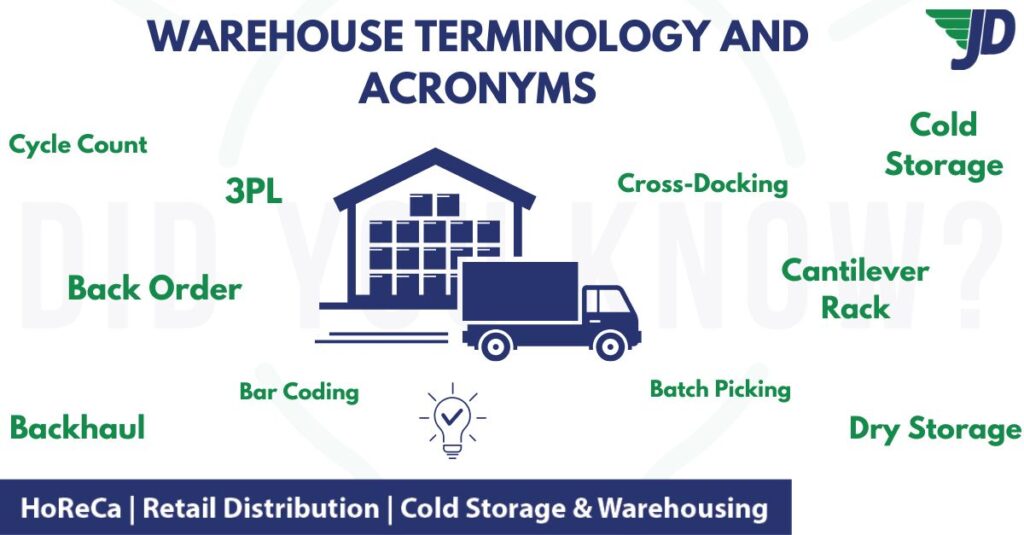
3PL (Third-Party Logistics)
A 3PL provider offers logistics services such as transportation, storage, inventory management, and order fulfillment on behalf of other businesses. Many businesses turn to third party logistics warehousing solutions specifically to access this kind of storage and fulfilment support without owning their own facilities.
Backhaul
The process of transporting goods from their final destination back to their original location or another designated facility.
Back Order
An order placed for products that are temporarily unavailable but will be fulfilled once inventory is replenished.
Bar Coding
A system that uses machine-readable codes to track, identify, and manage inventory throughout warehouse operations.
Batch Picking
A warehouse picking method where multiple orders containing similar products are collected simultaneously to improve efficiency.
Bill of Lading (BOL)
An official shipping document that details the contents, quantity, and destination of goods being transported.
Cantilever Rack
A specialized storage system designed for long, bulky, or irregularly shaped products such as pipes, lumber, and steel bars.
Cold Storage
A temperature-controlled warehouse area used for storing perishable products, pharmaceuticals, dairy products, frozen foods, and other sensitive inventory. Reliable frozen food transportation india services often work hand-in-hand with cold storage facilities to maintain product quality from warehouse to delivery.
Cross-Docking
A logistics process where products are received and immediately sorted and shipped without being placed into long-term storage. This fast-turnaround approach shares similarities with quick commerce logistics india, where speed and minimal storage time are equally critical.
Cycle Count
An inventory auditing process where specific sections of inventory are counted regularly to maintain stock accuracy without disrupting operations.
Dimensional Weight (DIM)
A pricing calculation used by shipping carriers that considers package dimensions rather than actual weight.
Dispatching
The process of scheduling, coordinating, and managing vehicles, shipments, and delivery routes. Efficient dispatching is closely tied to strong intra city logistics india networks that keep delivery routes running smoothly within urban areas.
Distribution Center
A facility designed to receive, sort, process, store, and distribute goods to customers or retail locations.
Drop Trailer
A trailer left at a warehouse facility for loading or unloading and collected later by the carrier.
Dry Storage
A warehouse storage area maintained at room temperature for non-perishable products.
Estimated Time of Arrival (ETA)
The projected time when a shipment, vehicle, or vessel is expected to arrive at its destination.
Estimated Time of Departure (ETD)
The projected time when a shipment, vehicle, or vessel is expected to leave its point of origin.
Estimated Time of Delivery (ETD)
The estimated date and time when goods will be delivered to the customer or receiving location.
FIFO (First In, First Out)
An inventory management method where older stock is dispatched before newer inventory to minimize product aging.
FEFO (First Expired, First Out)
A stock rotation strategy commonly used in food and pharmaceutical warehousing, where products nearing expiration are shipped first. This approach is especially important for businesses using cold chain logistics delhi providers, where fast rotation helps prevent spoilage in transit.
Inventory Turnover
A key performance metric that measures how frequently inventory is sold and replenished over a specific period.
Kitting
The process of combining multiple products into a single package before shipping to customers.
Order Fulfillment
The complete process of receiving, processing, picking, packing, and delivering customer orders.
Pallet
A flat transport structure that enables efficient storage and movement of goods using forklifts or pallet jacks see how pallets are used in modern warehousing for a full breakdown.
Pick and Pack
A warehouse process where products are selected from inventory and packaged for shipment.
Putaway
The process of moving newly received inventory to its designated storage location within the warehouse.
RF Scanner
A radio-frequency scanning device used for real-time inventory tracking and warehouse management.
Safety Stock
Additional inventory maintained to prevent stockouts during unexpected demand increases or supply disruptions.
SKU (Stock Keeping Unit)
A unique identifier assigned to products for accurate inventory tracking and stock management.
Warehouse Management System (WMS)
Software designed to manage inventory, storage locations, receiving, picking, packing, and shipping operations within a warehouse.
Lead Time
The total time required from placing an order until the product is delivered.
Reverse Logistics
The process of managing product returns, repairs, recycling, and inventory movement back through the supply chain.
Why Understanding Warehouse Terms Matters
A strong understanding of warehouse terminology, warehouse terms abbreviations, and industry-specific warehouse vocabulary helps businesses:
- Improve communication with logistics providers
- Enhance inventory accuracy
- Reduce fulfillment errors
- Optimize warehouse operations
- Improve supply chain visibility
- Make better operational decisions
- Strengthen collaboration with 3PL partners
Whether you’re managing a distribution center, working with a logistics provider, or exploring warehousing services, knowing these common warehouse words can help you navigate operations more efficiently, including top cold storage suppliers in India. For businesses in Telangana, partnering with a third party logistics hyderabad provider is often a practical way to put this terminology into action.
Looking for 3PL Warehousing and Logistics Services?
JustDeliveries provides warehousing, inventory management, cold storage solutions, and third-party logistics services in India designed to help businesses streamline their supply chains. Our team helps clients improve operational efficiency through reliable warehouse management and fulfillment solutions.
Frequently Asked Questions
Q1. How is warehouse terminology used in daily operations?
Warehouse terminology helps teams communicate clearly about inventory management, shipping, storage, fulfillment, and logistics processes.
Q2. How does a Warehouse Management System (WMS) improve efficiency?
A WMS automates inventory tracking, order processing, storage management, and reporting, helping reduce errors and improve productivity.
Q3. Can understanding warehouse vocabulary improve inventory management?
Yes. Understanding warehouse vocabulary helps employees accurately track stock, manage orders, and maintain inventory accuracy.
Q4. Is a distribution center different from a warehouse?
Yes. A warehouse primarily stores goods, while a distribution center focuses on receiving, processing, and shipping products efficiently.
Q5. Is cross-docking suitable for all businesses?
No. Cross-docking works best for fast-moving inventory and businesses that require minimal storage time.
Q6. Will using warehouse acronyms improve communication?
Yes. Familiarity with common warehouse acronyms such as SKU, WMS, ETA, and BOL improves communication between warehouse teams, suppliers, and logistics partners.
Q7. What are the most common warehouse terms abbreviations?
Some common warehouse terms abbreviations include SKU, WMS, BOL, ETA, ETD, FIFO, FEFO, and 3PL.
Q8. Why is warehouse terminology important in logistics?
Warehouse terminology creates a common language across supply chain operations, helping businesses improve efficiency, reduce misunderstandings, and manage inventory effectively.

Mansi Mahansaria
I’m Mansi Mahansaria, CEO and Founder of JustDeliveries, a B2B logistics company specializing in the food and beverage sector. With a background in Chemical Technology (ICT Mumbai), an MBA (FMS Delhi), and experience at IDFC Private Equity and Tata Group, I’ve built a plug-and-play logistics network helping F&B brands scale efficiently. I also share insights on entrepreneurship and logistics at industry and academic events.