
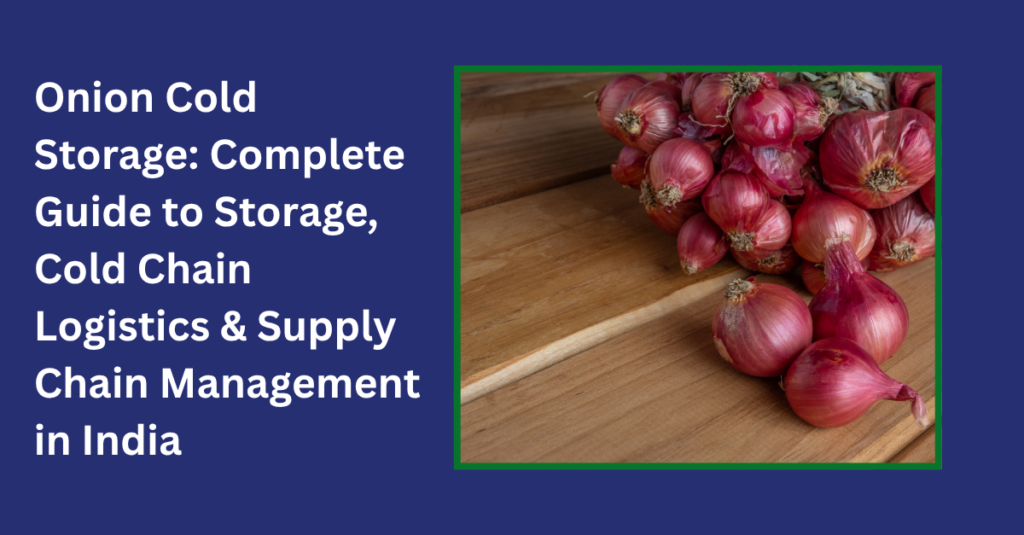
Onion cold storage is a temperature- and humidity-controlled storage system that helps reduce post-harvest losses, extend shelf life, and maintain onion quality. When combined with efficient onion storage techniques and a reliable cold chain, businesses can minimize spoilage, stabilize supply, and improve profitability across the onion supply chain in India.
Onion cold storage is one of the most effective ways to preserve onion quality, reduce wastage, and ensure year-round availability. For growers, traders, processors, and retailers, proper storage is only part of the solution, maintaining product quality during transportation is equally important. At JustDeliveries, businesses benefit from technology-enabled cold-chain logistics that keep temperature-sensitive products moving efficiently from storage facilities to distribution hubs. These same principles apply broadly across cold food storage practices for other perishable categories as well. Read on to discover how the right storage and logistics strategy can transform your operations.
What Is Onion Cold Storage?
Onion cold storage refers to specialized storage facilities designed to maintain ideal environmental conditions for harvested onions. Unlike ordinary warehouses, these facilities carefully regulate temperature, humidity, and airflow to preserve freshness while reducing sprouting, dehydration, and microbial damage.
Although onions are relatively hardy compared to many vegetables, they remain vulnerable to quality deterioration if stored improperly. A well-managed storage system helps businesses maintain consistent product quality, reduce losses, and respond to market demand throughout the year. More delicate produce, such as those covered under mango cold storage practices, requires even tighter environmental control to prevent similar quality loss.
Why Onion Cold Storage Is Essential in India
India is among the world’s largest onion producers, yet significant post-harvest losses continue to affect farmers, traders, and food businesses every season. Variations in weather, inadequate storage infrastructure, and long transportation distances contribute to these challenges.
Implementing onion cold storage offers several advantages:
- Extends storage life after harvest
- Reduces spoilage and shrinkage
- Maintains market quality
- Improves inventory planning
- Helps businesses sell during favourable market conditions
- Supports uninterrupted supply to retailers and food service businesses
For businesses operating at scale, storage alone is not enough. Efficient logistics must work alongside storage to preserve quality until products reach their destination. This is where reliable frozen food transportation India networks play an equally important role in protecting product quality once it leaves the warehouse.
Best Onion Storage Techniques for Maximum Shelf Life
Successful storage begins well before onions enter a cold room. Following proven onion storage techniques can significantly improve shelf life and reduce unnecessary losses.
Proper Curing
Freshly harvested onions should be cured before storage to dry the outer skin and seal the neck, reducing the risk of moisture-related decay.
Temperature Control
Maintaining stable temperatures is essential. Frequent fluctuations can encourage sprouting and affect product quality.
Humidity Management
Balanced humidity helps prevent excessive drying without creating conditions favourable for mould or rot.
Adequate Air Circulation
Good ventilation removes excess heat and moisture, ensuring onions remain dry and evenly cooled throughout the storage period.
Organized Stacking
Using pallets and proper stacking methods improves airflow while reducing pressure damage.
Inventory Rotation
Following the First-In, First-Out (FIFO) principle ensures older stock is distributed before newer inventory, maintaining product freshness.
Ideal Conditions for Onion Storage
Every storage facility should regularly monitor key environmental parameters.
| Storage Parameter | Recommended Practice |
| Temperature | Stable, crop-specific conditions |
| Relative Humidity | Carefully balanced to prevent moisture damage |
| Airflow | Continuous and uniform circulation |
| Inspection | Regular quality monitoring |
| Stock Rotation | FIFO inventory management |
Modern monitoring systems make it easier to identify potential issues before they affect product quality.
The Role of Onion Cold Chain Logistics
Proper storage protects onions only while they remain inside the facility. Once shipments leave the warehouse, maintaining quality depends on efficient onion cold chain logistics.
Temperature-controlled transportation helps preserve product integrity during movement between farms, storage facilities, distribution centres, processing units, wholesalers, and retailers.
An effective cold chain includes:
- Temperature-controlled vehicles
- Real-time shipment visibility
- Route optimisation
- Timely deliveries
- Continuous temperature monitoring
- Reduced handling delays
Without reliable transportation, even perfectly stored onions can lose quality before reaching customers. In major metro markets, dedicated frozen food transport Mumbai services reflect how this level of reliability is maintained across high-volume distribution.
Strengthening the Onion Supply Chain in India
The onion supply chain India depends on multiple interconnected stages, from harvesting and storage to transportation and retail distribution. Delays or temperature deviations at any point can increase waste and reduce profitability.
A modern supply chain typically includes:
- Farms and producer organisations
- Collection centres
- Cold storage facilities
- Distribution hubs
- Wholesale markets
- Food processors
- Retail stores
- Food service businesses
As demand for fresher produce grows, supply chains must become faster, smarter, and more transparent.
Technology Is Transforming Cold Storage and Logistics
Today’s cold chain is no longer driven solely by refrigeration—it is powered by data.
Businesses increasingly rely on:
- IoT temperature sensors
- GPS-enabled fleet tracking
- Digital warehouse management
- Automated compliance reporting
- Predictive maintenance
- Live operational dashboards
One example is the HQ App from JustDeliveries. It provides a centralized dashboard where food and beverage brands can monitor live vehicle movements, temperature compliance, SLA performance, billing, and AI-driven operational insights in real time. This visibility enables businesses to make informed decisions while improving service consistency across their logistics network. The same technology supports dairy operations, where consistent cold storage for milk India performance depends heavily on this kind of real-time monitoring.
Meeting the Demands of Quick Commerce
The rapid growth of quick commerce has transformed food distribution across India. Retailers and grocery platforms now expect faster replenishment while maintaining strict temperature compliance.
JustDeliveries supports cold-chain logistics for leading quick-commerce platforms including Swiggy Instamart, Zepto, Blinkit, Amazon, JioMart, and BigBasket. The company manages hub-to-hub transportation and dark store deliveries using real-time tracking and temperature-controlled vehicles, helping businesses meet demanding delivery timelines without compromising product quality. In high-density regions, dependable frozen food transport Delhi services illustrate how this network supports rapid replenishment cycles.
This capability is especially valuable for businesses handling perishable products that require dependable logistics throughout every stage of distribution.
Why Businesses Need an Integrated Logistics Partner
Managing storage, transportation, compliance, and distribution through separate vendors often creates operational gaps.
An integrated logistics partner helps businesses by providing:
- Temperature-controlled transportation
- Cold storage support
- Warehouse integration
- Technology-enabled tracking
- Delivery performance monitoring
- Centralized reporting
- Scalable logistics solutions
This integrated approach improves operational efficiency while reducing risks associated with fragmented supply chains. In southern markets, established frozen food transport Bangalore services show how this same integrated approach scales to meet growing regional demand.
Industry insights shared by Mansi Mahansaria highlight that digital visibility and temperature assurance are becoming essential differentiators for modern food logistics, particularly as businesses expand into multiple cities and distribution channels.
Conclusion
Onion cold storage remains one of the most effective solutions for reducing post-harvest losses and maintaining consistent product quality. However, successful preservation depends on much more than storage alone. Businesses also need effective onion storage techniques, dependable onion cold chain logistics, and a resilient onion supply chain India to ensure products reach customers in excellent condition.
As quick commerce, organised retail, and food processing continue to expand, integrated cold-chain solutions will play an even greater role in maintaining quality and improving operational efficiency.
Whether you’re an onion producer, wholesaler, processor, or distributor, partnering with an experienced logistics provider can help protect product quality from warehouse to destination.
At JustDeliveries, businesses benefit from technology-enabled cold-chain logistics, real-time shipment visibility, temperature-controlled transportation, integrated warehousing, and digital operational insights that simplify complex food supply chains. As Mansi Mahansaria often emphasizes through industry-focused content, resilient logistics is no longer just an operational requirement—it is a competitive advantage.
Frequently Asked Questions
Q1. What is onion cold storage?
Onion cold storage is a controlled storage system that regulates environmental conditions to preserve onion quality, reduce spoilage, and extend shelf life.
Q2. What are the best onion storage techniques?
Proper curing, stable temperatures, balanced humidity, adequate ventilation, organised stacking, and FIFO inventory management are among the most effective onion storage techniques.
Q3. How does onion cold chain logistics reduce losses?
By maintaining appropriate temperatures throughout transportation, reducing delays, and providing real-time monitoring, cold-chain logistics helps minimise spoilage and quality deterioration.
Q4. How does technology improve onion logistics?
IoT sensors, GPS tracking, live dashboards, automated compliance reports, and digital fleet management improve visibility, efficiency, and operational control.
Q5. Can onions be stored for long periods?
Yes. When stored under suitable environmental conditions and monitored regularly, onions can maintain quality for significantly longer than in conventional storage.
Q6. Is cold storage enough to protect onion quality?
No. Effective transportation, temperature-controlled logistics, and proper handling are equally important for maintaining quality throughout the supply chain.
Q7. Why is the onion supply chain in India important?
A well-managed onion supply chain India helps reduce food waste, improve availability, stabilize pricing, and deliver consistent quality across wholesale and retail markets.
Q8. Will integrated cold-chain logistics improve business efficiency?
Yes. Combining storage, transportation, technology, and real-time monitoring improves inventory management, delivery performance, product quality, and overall operational efficiency.

Mansi Mahansaria
I’m Mansi Mahansaria, CEO and Founder of JustDeliveries, a B2B logistics company specializing in the food and beverage sector. With a background in Chemical Technology (ICT Mumbai), an MBA (FMS Delhi), and experience at IDFC Private Equity and Tata Group, I’ve built a plug-and-play logistics network helping F&B brands scale efficiently. I also share insights on entrepreneurship and logistics at industry and academic events.