The quick commerce supply chain in India relies on strategically located dark stores, real-time inventory management, regional warehouses, cold-chain logistics, and hyperlocal last-mile delivery networks. Advanced technology helps businesses forecast demand, manage stock, and optimize delivery routes, enabling products to reach customers within 10–30 minutes while maintaining quality and operational efficiency.
Understanding how quick commerce supply chain works in India is essential for brands looking to succeed in today’s fast-paced delivery ecosystem. As consumer demand for instant deliveries continues to grow, companies rely on a combination of warehousing, inventory planning, dark stores, and logistics technology to fulfill orders rapidly. At JustDeliveries, we help food and beverage brands navigate this evolving landscape through specialized cold-chain logistics and supply chain solutions. Explore our dedicated quick commerce logistics India services to see how we support brands operating in this space.
What Is Quick Commerce?
Quick commerce, often called Q-commerce, is a retail fulfillment model designed to deliver products within minutes rather than days. Unlike traditional eCommerce, which typically operates through large centralized warehouses, quick commerce uses a network of smaller fulfillment centers located closer to customers.
These fulfillment centers, commonly known as dark stores, stock high-demand products and enable businesses to process and dispatch orders almost immediately after they are placed.
Today, platforms such as Blinkit, Zepto, Swiggy Instamart, BigBasket, and Amazon Fresh have transformed consumer expectations, making speed a key differentiator in retail. If you’re also exploring how quick service formats intersect with this model, our guide on what is a quick service restaurant offers useful context on how speed-first operations are structured across different food business formats.
Why Quick Commerce Is Growing Rapidly in India
Several factors are driving the rapid expansion of quick commerce across India:
- Increasing urbanization
- Smartphone-driven purchasing behavior
- Growing demand for convenience
- Busy lifestyles and time-sensitive shopping needs
- Expansion of hyperlocal logistics infrastructure
Consumers no longer want to wait days for groceries, dairy products, frozen foods, or daily essentials. This shift has created enormous opportunities for brands capable of building efficient supply chains.
How Quick Commerce Supply Chain Works in India
To understand how quick commerce supply chain works in India, it’s important to examine each stage of the process.
1. Procurement and Supplier Management
Every quick commerce operation begins with sourcing products from manufacturers, distributors, and food brands.
Companies analyze consumer demand patterns to determine which products should be stocked in specific locations. Data-driven forecasting helps prevent overstocking while ensuring popular products remain available.
This foundation is critical to how quick commerce supply chain works in India, as inventory accuracy directly impacts delivery performance.
2. Regional Warehousing and Distribution Centers
Before products reach local fulfillment hubs, they are stored in larger regional warehouses.
These facilities serve multiple purposes:
- Bulk inventory storage
- Inventory replenishment
- Demand balancing across locations
- Quality control management
Regional warehouses ensure dark stores remain adequately stocked without carrying excessive inventory.
3. Dark Stores: The Backbone of Quick Commerce
Dark stores are one of the most important components of how quick commerce supply chain works in India.
Unlike retail stores, dark stores are not open to consumers. Instead, they function as micro-fulfillment centers strategically positioned near high-demand neighborhoods.
Their advantages include:
- Faster order processing
- Reduced delivery distances
- Better inventory control
- Improved delivery speed
By placing inventory closer to customers, businesses can significantly reduce fulfillment times.
4. Real-Time Inventory Management
Inventory visibility is essential in quick commerce.
Advanced software continuously tracks:
- Product availability
- Stock movement
- Shelf life
- Replenishment requirements
Real-time visibility helps prevent stockouts and improves customer satisfaction.
This level of inventory control plays a major role in how quick commerce supply chain works in India, particularly for perishable and high-demand products.
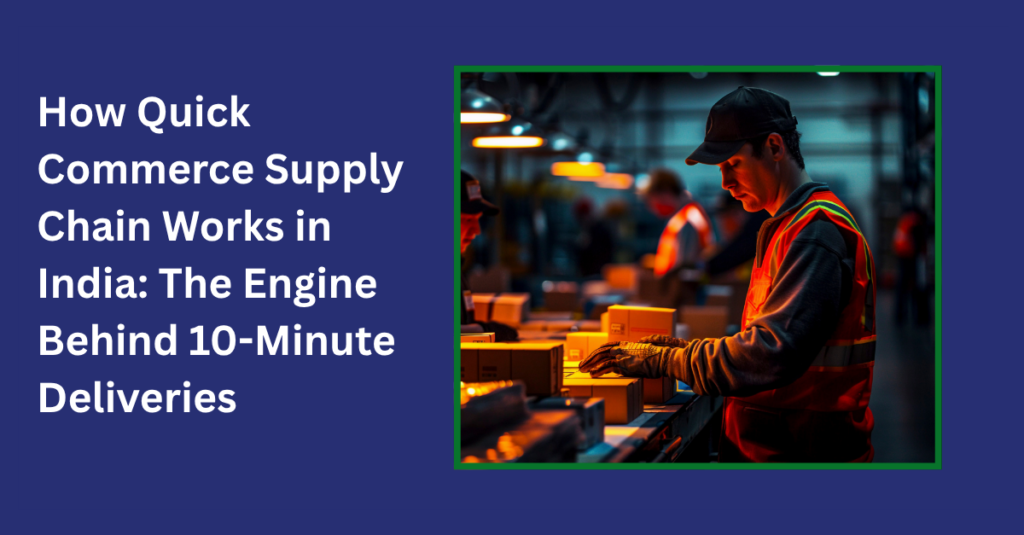
5. Order Processing and Picking
When a customer places an order, the nearest dark store receives the request instantly.
The workflow typically includes:
- Order allocation
- Product picking
- Quality verification
- Packaging
- Dispatch preparation
Modern picking systems help employees locate products quickly, reducing fulfillment delays.
6. Last-Mile Delivery
The final stage of how quick commerce supply chain works in India involves last-mile delivery.
Delivery management systems automatically assign riders based on:
- Distance
- Traffic conditions
- Delivery capacity
- Route efficiency
Sophisticated route optimization software helps drivers reach customers in the shortest possible time. Efficient intra city logistics India infrastructure is what makes this last-mile speed possible at scale, connecting dark stores to customers across dense urban zones.
The Role of Cold Chain Logistics in Quick Commerce
Not all products can be transported under standard conditions.
Items such as:
- Dairy products
- Ice cream
- Frozen foods
- Fresh beverages
- Ready-to-cook meals
require temperature-controlled transportation and storage.
Without a reliable cold chain, product quality can deteriorate quickly. For brands managing frozen food transportation India operations, maintaining unbroken temperature control from warehouse to doorstep is a non-negotiable requirement.
This is where specialized logistics providers become essential.
JustDeliveries powers cold-chain logistics for leading eCommerce and quick commerce ecosystems, including Swiggy Instamart, Zepto, Blinkit, Amazon, JioMart, and BigBasket. The company manages hub-to-hub transportation and dark store deliveries with real-time tracking and temperature-controlled operations to help maintain product integrity throughout the supply chain. Brands based in or expanding into southern India can leverage our cold chain logistics Hyderabad network for reliable, compliant cold-chain coverage across the region.
Technology That Powers Quick Commerce
Technology is at the heart of how quick commerce supply chain works in India.
Modern supply chains depend on:
- AI-Powered Demand Forecasting: Artificial intelligence analyzes purchasing trends to predict future demand accurately.
- Route Optimization: Algorithms identify the fastest delivery routes while minimizing operational costs.
- Real-Time Tracking: Brands can monitor shipments and vehicle movements continuously.
- Temperature Monitoring: Cold-chain shipments require continuous temperature visibility to ensure compliance.
- Performance Analytics: Operational data helps businesses improve efficiency and service levels over time.
The Importance of Visibility and Control
As quick commerce networks grow, visibility becomes increasingly important.
To address this challenge, JustDeliveries offers its proprietary HQ App, a centralized dashboard designed specifically for food and beverage brands.
The platform provides:
- Live vehicle tracking
- Temperature compliance monitoring
- SLA tracking
- Billing visibility
- AI-driven performance insights
By consolidating operational data into a single interface, brands gain greater control over their logistics operations while improving decision-making.
Common Challenges in Quick Commerce Supply Chains
Although the model offers significant advantages, it also presents operational challenges.
- High Last-Mile Costs: Frequent deliveries with small basket sizes increase transportation expenses.
- Inventory Accuracy: Even minor inventory discrepancies can impact fulfillment performance.
- Product Freshness: Maintaining quality is critical, particularly for food and beverage products.
- Demand Volatility: Consumer demand can fluctuate dramatically throughout the day.
- Network Complexity: Managing multiple warehouses, dark stores, and delivery partners requires strong coordination.
Addressing these challenges is fundamental to understanding how quick commerce supply chain works in India successfully. For businesses looking to build or expand their role in this ecosystem, our guide on how to become a logistics partner for quick commerce outlines the key requirements and steps involved.
Quick Commerce vs Traditional eCommerce Supply Chains
| Factor | Quick Commerce | Traditional eCommerce |
| Delivery Time | 10–30 Minutes | 1–7 Days |
| Fulfillment Centers | Dark Stores | Central Warehouses |
| Inventory Placement | Hyperlocal | Regional |
| Basket Size | Small | Larger |
| Customer Expectations | Instant Delivery | Scheduled Delivery |
This comparison highlights why how quick commerce supply chain works in India differs significantly from conventional eCommerce operations.
The Future of Quick Commerce in India
The future of how quick commerce supply chain works in India will be shaped by:
- AI-driven forecasting
- Smart warehousing
- Expanded cold-chain infrastructure
- Greater automation
- Increased penetration into Tier 2 and Tier 3 cities
As consumer expectations continue to evolve, businesses will need increasingly sophisticated supply chains to remain competitive.
Why Specialized Logistics Partners Matter
For food and beverage brands, building an efficient quick commerce network independently can be expensive and operationally challenging.
Specialized logistics providers bring:
- Cold-chain expertise
- Warehousing infrastructure
- Inventory visibility
- Technology integration
- Scalable transportation networks
This allows brands to focus on growth while maintaining service quality. For brands evaluating external support, our guide on how to choose a logistics partner for food brand India covers the critical factors to assess before making a decision.
Those based in Hyderabad can also explore our third party logistics Hyderabad services for scalable, city-level logistics support.
Partner with JustDeliveries for Scalable Quick Commerce Logistics
A successful quick commerce operation depends on speed, visibility, reliability, and temperature control.
JustDeliveries supports food and beverage brands with specialized warehousing, inventory management, cold-chain transportation, and distribution services designed for modern commerce. From hub-to-hub transfers and dark store replenishment to real-time shipment tracking and performance analytics, JustDeliveries helps businesses build resilient supply chains that support rapid growth.
Whether you’re supplying quick commerce platforms, retailers, cloud kitchens, or distributors, JustDeliveries provides the logistics expertise needed to keep products moving efficiently across every stage of the supply chain.
Frequently Asked Questions
Q1. What is a quick commerce supply chain?
A quick commerce supply chain is a logistics network designed to fulfill and deliver orders within minutes using dark stores, local inventory hubs, real-time inventory systems, and hyperlocal delivery networks.
Q2. How does a dark store support quick commerce?
Dark stores act as micro-fulfillment centers located near customers. They enable faster picking, packing, and dispatching of orders, significantly reducing delivery times.
Q3. Why is cold chain logistics important in quick commerce?
Cold chain logistics helps maintain the required temperature for products such as dairy, frozen foods, beverages, and ready-to-eat meals, ensuring quality and safety during storage and transportation.
Q4. Can quick commerce work without dark stores?
While technically possible, quick commerce operations are far less efficient without dark stores because delivery times increase and inventory availability becomes harder to manage.
Q5. Is quick commerce different from traditional eCommerce?
Yes. Quick commerce focuses on ultra-fast deliveries through hyperlocal fulfillment centers, while traditional eCommerce typically uses centralized warehouses and longer delivery windows.
Q6. How do companies achieve 10-minute deliveries?
Companies use strategically located dark stores, real-time inventory management, automated order allocation, and route optimization software to minimize fulfillment and transportation times.
Q7. Will quick commerce continue growing in India?
Industry trends suggest continued growth due to urbanization, changing consumer behavior, improved logistics infrastructure, and increasing investment in supply chain technology.
Q8. What role does technology play in how quick commerce supply chain works in India?
Technology enables inventory visibility, demand forecasting, route optimization, temperature monitoring, and real-time tracking, making quick commerce operations faster, more accurate, and scalable.

Mansi Mahansaria
I’m Mansi Mahansaria, CEO and Founder of JustDeliveries, a B2B logistics company specializing in the food and beverage sector. With a background in Chemical Technology (ICT Mumbai), an MBA (FMS Delhi), and experience at IDFC Private Equity and Tata Group, I’ve built a plug-and-play logistics network helping F&B brands scale efficiently. I also share insights on entrepreneurship and logistics at industry and academic events.